
Paris | SIGLA Studio
Barcelona / Spain / 2023
3
Was the location something you considered? How much did it influence you?
The location influenced us a lot, as this is a 90 m² apartment in the heart of the Eixample district in Barcelona, built in 1925. We wanted to be as respectful as possible with the surroundings and the original structure of the house, preserving the identity of a classic Eixample apartment with very characteristic construction elements from that time, typical of many buildings in this traditional Barcelona neighborhood.
It is, therefore, a home with high ceilings and spaces that resemble interconnected boxes, something very typical of early 20th-century modernist buildings. These boxes are created by the traditional system of load-bearing walls and ceilings with wooden beams and Catalan ceramic vaulting.
What is the layout?
The entrance is through a hallway where we restored all the original textures of the shared brick walls, and on the other side, we reintegrated the original texture with a lime and plaster finish. This hallway acts as a distributor for the different rooms of the house, accessed through solid pine wood doors that we restored.
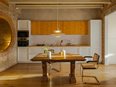
The most significant change was moving and relocating the kitchen (from a dark, interior area to the exterior), so it opens to the large interior courtyard of the block, with a southern orientation, enjoying natural cross-ventilation and natural light throughout the day.
We kept the master bedroom in its original location, but to bring in natural light, we made a circular opening in the load-bearing wall that divides the bedroom and the living room-kitchen area. For this, we only used handmade ceramic bricks from a local quarry, creating a natural discharge arch without the need for structural supports with beams. This way, we not only introduced natural light but also connected the space with different areas of the house, providing a greater sense of openness and linking the interior with the exterior.
On the other hand, we extended the strategy of restoring and reintegrating original textures to all rooms in the house, creating a thread that connects the various interconnected spaces.
What was clear to you before starting?
We understood comfort as the ultimate luxury. Intimacy and home as fundamental feelings we wanted to achieve. In practice, it turns out that it's much easier to measure discomfort than comfort. The convenience (of having a table within reach), the efficiency (of a modulated light source), the domesticity (of sipping coffee while watching the sunrise), physical comfort (deep chairs and cushions), intimacy (reading a book, having a conversation)—all these qualities combined contribute to the atmosphere of inner calm, part of the comfort we were looking for.
How was the process?
We focused on delving into memory, childhood, and moments lived in the house, isolating everything that interested us and seemed suggestive. This allowed us to preserve and recover as many elements as possible, while also introducing new ones, adapting the original space. We moved from a typical early-century layout, with a central kitchen and little natural light, to a new organization that modifies the original plan to create a daytime area, consisting of a single large space where different activities (living room – dining room – kitchen – study) are interconnected, achieving a communion between past, present, and therefore, the future.
What was preserved and what was renovated?
“The past awaits us tomorrow: it always moves faster than we do” – Estació de França (Joan Margarit)
We wanted to maintain the essence of the neighborhood home by restoring the ceilings and preserving their original structure of wooden beams and ceramic vaulting. Many of the beams had suffered fungal damage, so we had to reinforce them with metal profiles and apply antifungal treatment.
We also restored all the old doors, stripping them and recovering the wood. We did the same with the windows, replacing the 3mm single glass with thicker double-glazed panels. In the bathrooms, lime stucco covers all the walls, and the sinks are made from Carrara marble.
We left the handmade brick texture of the load-bearing walls exposed and complemented it with different techniques on the partitions: a combination of various ancient methods (potassium silicate glazes, lime finishes, and stucco depending on the area) to maintain and recover the aura of architectural honesty, working with the building materials themselves and leaving them visible, as was done in the past.
What was your moodboard, your inspiration?
(Re)building. The craftwork. Comfort and domesticity, describing a set of perceived emotions, not just an isolated attribute. Domesticity relates to family, intimacy, and a devotion to the home, as well as a feeling that the house embodies those emotions, not just shelters them.
In our own way, this is what we tried to convey with the intervention, rehabilitating a traditional apartment where several generations of the same family had lived.
Why did you choose these materials?
Because they are the same materials originally present in traditional Catalan architecture but have been lost over time. Pre-existing elements that guide us through the process. Materials such as wood, lime, or natural pigments. That’s why we opted to reintegrate rather than replace them.
Already present, ecological, and local materials with a very low carbon footprint. We used traditional techniques such as potassium silicates, lime stucco, trabadillos (traditional brickwork), wax glazes, lime paint (without an acrylic base), and natural open-pore oils, which maintain the essence of the materials and take advantage of their hygroscopic properties, along with natural cork-based insulation. All of this, combined with the natural north-south ventilation between the different rooms in the house, contributes to enhancing the sense of domesticity and comfort we sought.
Comfort and Singularity: (The Home. A Short History of an Idea – Witold Rybczynski. 1999)
Definition:
The first recorded use of the word "comfort" to indicate a level of domestic ease isn't documented until the 18th century.
People began using the word "comfort" differently because they needed a special term to communicate an idea that had not previously existed or required expression.
To understand this, we must consider an earlier period: the Middle Ages.
Most of the population at that time was very poor. Their homes were terrible. They had no running water, no sanitation, almost no furniture, and very few possessions. For these miserable people, concepts like "home" and "family" did not exist.
To speak of comfort or discomfort in these circumstances is absurd; it was merely a matter of survival.
The Intimate and the Private:
What is striking about medieval homes is not the lack of furniture but the multitude of people and the liveliness inside. These homes were always full of people. This was partly because, in the absence of restaurants, bars, or hotels, homes served as public meeting places for hosting and conducting business. They were also crowded because many people lived in them. Besides the immediate family, there were employees, servants, apprentices, friends, and dependents; households of up to 25 people were not uncommon. Since all these people lived in one or, at most, two rooms, privacy was unknown.
The concept of intimacy or privacy is also non-existent in many non-Western cultures, particularly in Japan. Since the Japanese lack an indigenous word to describe this concept, they have adopted an English term: praibashii (privacy in English).
Family:
The medieval idea of family was different from ours in many ways, especially in its unsentimental attitude towards childhood. It wasn't just the children of the poor who worked; in all families, children were sent away from home when they turned seven (as apprentices in craftsmen's homes, pages in noble households, etc.).
Now, children began to spend much more time at home than before. For the first time in centuries, parents could watch their children grow up.
The transition from the public, feudal house to the private, family home had begun. The growing sense of domestic intimacy was as much a human invention as any technological artifact. In fact, it may have been even more important, for it affected not only our material surroundings but also our consciousness.
“Home”:
The word home, which refers to both a physical place and the more abstract idea of a state of being, has no equivalent in Romance or Slavic European languages. German, Danish, Swedish, Icelandic, Dutch, and English all have homophones for home, all of which derive from the Old Norse heima.
Domesticity:
To talk about domesticity is to describe a set of perceived emotions, not just an isolated attribute. Domesticity has to do with family, intimacy, and a dedication to the home, as well as the feeling that the house embodies these sentiments, not just shelters them.
[ES]
Ha sido la ubicación algo que habéis tenido en cuenta? ¿Cuánto os ha influido?
La ubicación nos ha influido mucho, ya que se trata de un piso de 90 m2 en pleno Eixample de Barcelona, construido en 1925, por lo que queríamos ser lo más respetuosos posible con el entorno y la estructura original de la casa, manteniendo la identidad de un piso clásico del Eixample, con elementos constructivos muy característicos de la época, típicos de muchas de las fincas del tradicional barrio barcelonés.
Se trata pues, de una vivienda de techos altos, con espacios que parecen cajas comunicadas entre sí, algo muy propio de los edificios modernistas de principio de siglo XX. Estas cajas vienen dadas por el sistema tradicional de muros de carga y techos de vigas de madera y bóveda catalana de cerámica.
Cuál es su distribución?
La entrada se realiza a través de un pasillo en el que recuperamos todas las texturas originales del ladrillo medianero y las completamos en el otro costado con la reintegración de la textura original con un trabadillo de cal y yeso. Este pasillo, actúa como distribuidor de las distintas habitaciones de la casa a las que se accede mediante puertas macizas de madera de pino que restauramos.
El cambio más importante viene dado al desplazar y reubicar la cocina (desde una zona oscura y interior hacia el exterior) para que así quede abierta hacia el gran patio de interior de isla, con orientación Sur, gozando de ventilación natural cruzada y luz natural durante todo el día.
El dormitorio principal lo mantenemos en su ubicación original, pero para dotarle de luz natural realizamos una apertura circular en el muro de carga que divide dormitorio y salón - cocina. Para ello únicamente utilizamos un ladrillo cerámico manual de una cantera local, a modo de arco de descarga natural, sin necesidad de utilizar apeos mediante bigas.
De este modo no sólo dotamos de luz natural al espacio sino que lo relacionamos con las distintas zonas de la casa dando también una mayor sensación de amplitud y conectando el interior con el exterior.
Por otro lado, extendemos la estrategia de restauración y reintegración de texturas originales a todas las estancias de la casa, a modo de hilo conductor que relaciona los distintos espacios inter comunicados entre sí.
Qué teníais claro antes de empezar?
Entender el confort como el mayor de los lujos. Intimidad y hogar como sensaciones básicas que queríamos lograr. En la práctica, resulta que es mucho más fácil medir la falta de confort que el confort. La comodidad (de una mesa a mano), la eficiencia (de una fuente modulada de luz), la domesticidad (de una taza de café viendo amanecer) la comodidad física (sillas hondas y almohadones), la intimidad (leer un libro, charlar) Todas estas características sumadas contribuyen al clima de calma interior que es parte del confort que estábamos buscando.
Como ha sido el proceso?
Nos centramos en escarbar en la memoria, la infancia y los momentos vividos en la casa, aislando todo aquello que nos interesa y parece sugerente, para así mantener y recuperar el máximo de elementos posibles e introduciendo algunos nuevos, readaptando así el espacio original para pasar de una distribución típica de principios de siglo con la cocina en el centro, sin apenas luz natural, a una nueva organización que modifica el planeamiento inicial para incorporar una zona de día formada por un único gran espacio en la que las distintas actividades (salón – comedor – cocina – estudio) se relacionan entre si, logrando una comunión entre presente, pasado y por lo tanto futuro.
Qué se ha mantenido y qué se ha renovado?
“ El passat ens espera al demà: va sempre més de pressa que nosaltres “ Estació de França (Joan Margarit)
Queríamos mantener la esencia de la casa de barrio, rehabilitando los techos manteniendo su estructura original de vigas de madera y bovedilla cerámica.
Muchas de las vigas, habían sufrido ataques de hongos, por lo que debimos reforzarlas mediante perfiles metálicos y realizarles un tratamiento anti hongos.
Por otro lado, restauramos todas las puertas antiguas, decapándolas y recuperando la madera. Hicimos lo mismo con las ventanas, cambiándoles el vidrio simple de 3mm por un vidrio de cámara y mayor grosor. En los baños, un estucado de cal recubre todos los paramentos y las picas se realizan en mármol de carrara.
Dejamos vista la textura de ladrillo manual de los muros de carga y la complementamos con los revestimientos en los tabiques mediante la combinación de varias técnicas ancestrales (veladuras con silicato de potasio, trabadillos y estucados de cal (según la zona) para mantener y recuperar el aura de la honestidad arquitectónica, trabajando con los propios materiales de la construcción y dejándolos vistos, como se hacía antaño.
Cuál ha sido vuestro moodboard, vuestra inspiración?
(re) construir. El trabajo artesano. El confort y la domesticidad, describiendo un conjunto de emociones percibidas, no sólo un atributo aislado. La domesticidad tiene que ver con la familia, la intimidad y una consagración al hogar, así como una sensación de que la casa incorpora esos sentimientos, y no solo les da refugio. A nuestra manera, es lo que hemos intentado transmitir con la intervención hemos hecho para rehabilitar un piso tradicional en la que habían vivido varias generaciones de una misma familia.
Por qué la elección de estos materiales?
Porque se trata de los mismos materiales que han estado presentes originariamente en la arquitectura tradicional catalana pero que se han ido perdiendo con el tiempo. Pre existencias que nos guían en el proceso. Materiales tales como madera, cal o pigmentos naturales. Es por ello que optamos por reintegrar en lugar de reemplazar.
Materiales ya presentes. Ecológicos y autóctonos, con una huella de carbono muy baja. Usamos técnicas tradicionales tales como silicatos potásicos, estucados de cal, trabadillos, veladuras de cera, pintura de cal, sin base acrílica y aceites naturales, de poro abierto, que mantienen la esencia de los materiales y aprovechan de paso sus propiedades higroscópicas, aislamientos naturales a base de corcho, etc. Todo ello junto a la ventilación natural norte - sur entre las distintas estancias de la casa, contribuye a acentuar la sensación de domesticidad y confort que buscamos.
Sobre el confort y la singularidad (La casa. Historia de una idea – Witold Rybczynski. 1999)
Definición:
El primer empleo de la palabra “confort” para indicar un nivel de agrado doméstico no está documentado hasta el siglo XVIII.
La gente empezó a utilizar la palabra “confort” de forma diferente, porque necesitaba una palabra especial para comunicar una idea que anteriormente no había existido o no necesitaba expresión.
Para entenderlo debemos contemplar un período anterior: la Edad Media.
La mayor parte de la población en esa época era muy pobre. Tenían unas viviendas malísimas. No tenían agua corriente ni saneamiento, casi ningún mueble y pocas posesiones. Para aquellos miserables no existían conceptos como el de “casa” y “familia”
Hablar de confort o de incomodidad en esas circunstancias es absurdo; se trataba meramente de existir.
Lo íntimo y lo privado:
Lo que sorprende de las casas medievales no es la falta de muebles, sino la multitud y el pulso vital que había en su interior. Aquellas casas siempre estaban llenas de gente. Ello se debía en parte a que, al no existir restaurantes, bares ni hoteles, servían de lugares de reunión pública para recibir y para hacer negocios, pero también a que eran muchos quienes las habitaban. Además de la familia inmediata, había empleados, sirvientes, aprendices, amigos y protegidos; no eran raros los hogares de nada menos que veinticinco personas. Como toda esa gente vivía en una habitación, o como máximo dos, la intimidad era algo desconocido.
El concepto de intimidad, de lo privado, también es inexistente en muchas culturas no occidentales, concretamente en el Japón. Como los japoneses carecen de una palabra autóctona para describir esa cualidad, han adoptado un término inglés: praibashii (privacy en inglés)
Familia:
La idea medieval de la familia era diferente de la nuestra en muchos sentidos, especialmente en su actitud nada sentimental hacia la infancia. No solo los hijos de los pobres trabajaban; en todas las familias, a los hijos se los enviaba fuera de casa cuando cumplían los siete años de edad (aprendices en casas de artesanos, pajes en casas de los nobles, etc) Ahora los hijos pasaban mucho más tiempo en casa que antes. Por primera vez en siglos, los padres podían ver como iban creciendo sus hijos.
Se había iniciado la transición de la casa pública feudal a la casa particular familiar. El sentimiento cada vez mayor de la intimidad doméstica tuvo tanto de invención humana como cualquier artefacto técnico. De hecho, quizá haya sido más importante, pues no solo afectó a nuestro entorno material, sino también a nuestra conciencia.
“Home”:
La palabra home, que designa un lugar físico, pero que también tiene el sentido más abstracto de un estado de ser, no tiene equivalente en los idiomas romances o eslavos europeos. Tanto el alemán como el danés, el sueco, el islandés, el holandés y el inglés tienen palabras homófonas para decir home, todas ellas derivadas del antiguo noruego heima.
Domesticidad:
Hablar de domesticidad es describir un conjunto de emociones percibidas no tan solo un atributo aislado. La domesticidad tiene que ver con la familia, la intimidad y una consagración al hogar, así como una sensación de que la casa incorpora esos sentimientos, y no solo les da refugio.
Lead Architects: Bernat Riera and Sergi Puig
Restoration work on original paint, flooring, and textures: ART MATERIA
Art direction and styling: Mariela Achon
Photography Credits: Marta Vidal (https://www.martavidal.com/)
3 users love this project
Enlarge image


Was the location something you considered? How much did it influence you? The location influenced us a lot, as this is a 90 m² apartment in the heart of the Eixample district in Barcelona, built in 1925. We wanted to be as respectful as possible with the surroundings and the original structure of the house, preserving the identity of a classic Eixample apartment with very characteristic construction elements from that time, typical of many buildings in this traditional Barcelona...
- Year 2023
- Work finished in 2023
- Client Bernat (architect and co-founder of SIGLA Studio)
- Status Completed works
- Type Apartments / Interior design / Residential renovation
- Websitehttps://www.siglastudio.es/en/projects/casa-sigla

comment