
The Forgotten Barn | Karnet architekti
Dobříš / Czech Rep. / 2022
9
Václav and Marie used to visit their grandmother in the small town of Dobříš, nestled at the foot of the Brdy Hills. When the opportunity arose to buy a plot of land with an old stone barn right next to her garden, they didn’t hesitate for a moment. They wanted their children to be able to visit their grandmother through secret passages in the fence, help her weed the flower beds, and, at the same time, put down their own roots. They hoped to create a space where they could listen to her stories and nurture a relationship that would remain with them for a lifetime.
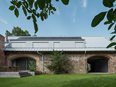
But what about the barn and its memories? Tear it down and build anew? Originally, that was one of the plans. After previous experiences, they didn’t want to go down the path of reconstruction. However, when they peeked inside, they immediately knew what to do with it. They decided to build a new home inside the barn. Its stone shell remained, the structure was stabilized, and a prefabricated wooden house was placed inside.
The layout was adapted to the original masonry and vaulted openings yet remained structurally completely separate. The boundary between the interior and exterior has dissolved. The new has woven itself through history, and today it’s difficult to determine where the inside begins and the outside ends. The path outside leads only through the atmosphere of the past and the traces left by previous generations.
The building, whose history dates back at least to 1912, clearly called for preservation. Hay was stored under the handcrafted roof beams, and farmers would pass through the arched stone passages with their carts. Over the years, however, the barn accumulated layers of plaster, extensions, and wooden elements. All of this had to make way for the new purpose.
Stripped back to its brick-and-stone shell, the building was approached with a care almost akin to heritage preservation. The stone walls, lacking foundations, were stabilized with a concrete overlay and, in some areas, cladding, which helped preserve and protect them from further deterioration. We removed the old roof and, after years, reopened the original ventilation openings. Due to its poor technical condition, the internal vertical bracing wall had to be replaced with a steel structure arching over the passage in the northern part. The new foundation slab was placed within the building with enough clearance to avoid compromising the stone walls. At this point, the building was ready for its new phase.
From the first concept, we knew that the stability of the original walls’ foundations must not be compromised, so it was clear that a timber structure would be inserted into the barn. A major challenge was solving the roof structure, ceiling constructions, and the generous roof overhangs designed to extend over the top of the stone walls for their protection, combined with the longitudinal dormer. Thanks to the collaboration with the engineers from Martinice Group, everything was resolved without any need for changes to the original concept, and the shell of the building was completed in just ten days.
Given the height of the original wall, the contractors designed slanted supports for the rafters of the overhang, which proved to be a very elegant solution, even in the areas under the dormers. The perimeter structure was designed to be very slender, which allowed us to gain several centimeters of additional space inside. The wall assembly is only 333 mm thick and is diffusely open, which was essential for natural ventilation. Additionally, it features an installation cavity, which we often use to adjust the positions of light fixtures, switches, and outlets.
The barn divides the plot into two halves, creating two gardens with different characteristics, whether in terms of privacy or the time of day when direct sunlight falls on them. Each half offers a different way of use, whether for relaxation or practical purposes, which proved to be crucial for the layout of the inserted timber structure.
The access to the house is from the west, which allowed the use of the upper northern pair of vaulted passages as an open parking space while also providing space for larger equipment to pass through to the other half of the plot. Right next to the passage, in the upper part of the house, is a workshop and an outdoor storage area for seasonal sports equipment, covered by the upper floor.
The main living area is situated between the second pair of vaulted passages, in the southern part of the house. In front of the passages are two terraces, one facing the quieter half of the plot, filled with afternoon sunlight, while the opposite terrace welcomes the morning rays. As a result, there was no need to visually disrupt the stone wall of the barn with a traditional pergola. You simply choose the terrace where it’s most comfortable at the moment.
The morning rays filter through east-facing windows into the children's rooms and the upstairs bedroom, which also includes two bathrooms and a study connected to the guest room and a small gym. Above the passage, a large terrace was created on the upper floor. A key element of the design was working with light. To bring as much light as possible into the interior, part of the roof is glazed, and the building uses large-format windows, through which light flows into the living space, guided by the offset stone wall. The common living area is connected to the kitchen and dining room, allowing the family to remain in constant contact. The ground floor also includes a technical bathroom.
[CZ]
Do ani ne desetitisícové Dobříše v podhůří Brdské vrchoviny jezdili Václav s Marií za babičkou. Když se objevila příležitost koupit pozemek se starou kamennou stodolou hned vedle její zahrady, neváhali ani na moment. Chtěli, aby děti mohly tajnými průchody v plotu babičku navštěvovat, pomáhat jí s plením záhonků, a přitom tu zapouštět vlastní kořeny. Aby naslouchali jejímu vyprávění, a rozkvétal vztah, na který budou vzpomínat do konce života.
Co ale se stodolou a jejími vzpomínkami? Strhnout a stavět znovu? Původně to byl jeden ze záměrů. Rekonstruovat po předchozích zkušenostech nechtěli. Pak ale nahlédli dovnitř a hned věděli, jak s ní naloží. Ve stodole se rozhodli postavit nový dům. Její kamenné torzo zůstalo, konstrukce byla stabilizována a dovnitř vložena prefabrikovaná dřevostavba.
Ta se dispozičně podřídila původnímu zdivu a klenutým otvorům, zároveň však zůstala konstrukčně zcela oddělena. Hranice mezi interiérem a exteriérem se rozplynuly. Nové prorostlo historií skrz naskrz, a dnes je těžké určit, kde začíná vnitřek a končí vnějšek. Cesta ven vede jen skrze atmosféru minulosti a stopy, které zde zanechaly předchozí generace.
Objekt, jehož historie sahá minimálně do roku 1912, si o zachování vyloženě říkal. Seno se skladovalo pod ručně opracovanými trámy krovu a sedláci projížděli s vozy pod klenutými kamennými průjezdy. Během let svých služeb však stodola získala řadu nánosů omítek, přístaveb a dřevěných prvků. To všechno muselo ustoupit novému využití.
Objekt byl očištěn na cihlovo-kamenné torzo, ke kterému jsme přistupovali s opatrností téměř památkové ochrany. Kamenné zdi bez základů byly stabilizovány nadbetonávkou, a místy i oplechováním, které ji zakonzervovalo a zabezpečilo vůči degradaci. Odstranili jsme starou střechu a po letech otevřeli původní větrací průduchy. Vnitřní kolmá ztužující zeď musela být vzhledem ke svému technickému stavu v severní části nahrazena ocelovou konstrukcí klenoucí se nad průjezdem. Novou základovou desku jsme umístili do objektu s takovým odstupem, aby nebyly ohroženy kamenné zdi. V ten moment byl objekt připraven na svou novou etapu.
Od prvního konceptu jsme věděli, že nesmí dojít k ovlivnění stability základů původních zdí, proto bylo jasnou volbou vložit do stodoly dřevostavbu. Velkou výzvou se ukázalo být řešení krovů, stropních konstrukcí a velkorysých přesahů střechy navržených přes vrch kamenných zdí pro jejich ochranu, v kombinaci s podélným vikýřem. Díky spolupráci s inženýry dodavatele Martinice Group se vše podařilo vyřešit bez nutnosti jakýchkoliv úprav původního konceptu, a hrubá stavba byla nakonec hotová za pouhých deset dnů.
Vzhledem k výšce původní zdi navrhli dodavatelé šikmé podepření krokví přesahu, což se ukázalo jako velmi elegantní řešení i v místě přesahů pod vikýři. Obvodové konstrukce navrhli velmi subtilní, čímž jsme získali několik desítek centimetrů ve vnitřním prostoru. Skladba stěny je tlustá jen 333 mm, je difuzně otevřená, což bylo zásadní pro přirozené větrání. Navíc má instalační předstěnu, kterou jsme nejednou využili při dodatečné úpravě pozic koncových prvků světel, vypínačů a zásuvek.
Stodola rozděluje pozemek na dvě poloviny, a tak vytváří dvě zahrady různého charakteru, ať už z hlediska míry soukromí, nebo doby, kdy na ni dopadá přímé slunce. Každá polovina tedy nabízí různý způsob užívání, relaxační či užitný, což se ukázalo být zásadní pro dispoziční řešení vsazené dřevostavby.
Příjezd k domu je ze západní strany, což umožnilo využít horní, severní dvojici klenutých průjezdů jako otevřený přístřešek pro parkování a zároveň prostor pro průjezd větší techniky na druhou polovinu pozemku. Hned u průjezdu se v horní části domu nachází také dílna a venkovní sklad na sezónní sportovní vybavení kryté nadzemním podlažím.
Hlavní obytná část byla situována mezi druhou dvojicí klenutých průjezdů, v jižní části domu. Před průjezdy se rozprostírají dvě terasy, jedna směřující do klidnější poloviny pozemku plné odpoledního slunce, zatímco protilehlá terasa vítá ranní sluneční paprsky. Díky tomu nebylo nutné kamennou stěnu stodoly opticky narušovat klasickou pergolou. Prostě si jen stačí vybrat tu terasu, na které je zrovna příjemněji.
Ranní paprsky pronikají okny orientovanými na východ i do dětských pokojů a ložnice v patře, kde se nachází i dvě koupelny a pracovna propojená s pokojem pro hosty a malou posilovnou. Nad průjezdem v patře vznikla také velká terasa. Velkým tématem se v návrhu stala práce se světlem. Aby jej do interiéru pronikalo co nejvíce, je část střechy prosklená, objekt využívá velkoformátová okna, skrze která proniká do obývacího prostoru světlo sváděné po odsazené kamenné zdi. Společenská část je propojená s kuchyní a jídelnou, díky čemuž může být rodina stále v kontaktu. Součástí přízemí je i technická spodní koupelna.
Photography: Petr Polák
Collaborators and suppliers Construction company: MARTINICE GROUP
Furniture joiner: Milan Krejčí
9 users love this project
Enlarge image


Václav and Marie used to visit their grandmother in the small town of Dobříš, nestled at the foot of the Brdy Hills. When the opportunity arose to buy a plot of land with an old stone barn right next to her garden, they didn’t hesitate for a moment. They wanted their children to be able to visit their grandmother through secret passages in the fence, help her weed the flower beds, and, at the same time, put down their own roots. They hoped to create a space where they...
- Year 2022
- Work finished in 2022
- Status Completed works
- Type Single-family residence / Interior design / Building Recovery and Renewal

comment