
Principal | SIGLA Studio
Barcelona / Spain / 2019
4
A young couple with two small children and a cat decide to invest in a life project and purchase a home with a surface area of about 220 m² in the Eixample neighborhood of Barcelona. When they become homeowners, they encounter questions that might arise for any of us in a similar situation, and they reconsider how they want to live moving forward.
In our first meeting at the office, we make it clear that the most important thing is for them to lead the way, not us. They are the ones driving the process. We, in turn, guide them through the journey. Concepts such as home, sustainability, relationship with the exterior space, and materiality come to the table. Through dialogue, we realize that architecture is a language.
This brings to mind John Summerson, who states that the classical language of architecture is akin to the "Latin" of architecture, something that can be immediately recognized when seen. (The Classical Language of Architecture - John Summerson)
In our case, the flat to be renovated was located in a stately building in the Eixample, built in 1945, with elements very characteristic of Catalan modernism, aligned with the classicism that defines the traditional Barcelona neighborhood. It was a flat with high ceilings, spaces that resemble interconnected boxes, something typical of early 20th-century modernist buildings. These boxes were defined by the traditional system of load-bearing walls and steel or wooden beams with Catalan vaulted ceilings.
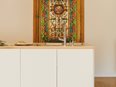
Thus, with our intervention, our main objective was to reinforce and consolidate the concept of a classic Eixample flat from the past century, through a concise and clear architectural language, recovering old elements (such as stained glass windows and original carpentry, ceramic barrel-vaulted ceilings, wooden moldings, etc.) while adapting them to current needs: relocating the kitchen to the center of the home and enhancing connections between rooms (through complex structural operations) to better relate the various spaces through a central axis that projects outward (kitchen - living room - dining room - outdoor space) and provides much greater natural light to each space.
The interior and exterior merge into a single space thanks to a large sliding glass window that disappears completely into the façade, allowing a total connection between them, a feature characteristic of Mediterranean climates like ours.
The day and night areas (master bedroom) are organized through a central hallway with vaulted ceilings, which was completely rehabilitated (relocation of side doors, openings, indirect lighting), enhancing the central symmetry concept so characteristic of the flat.
Regarding the materials used, there is a focus on natural materials such as wood (parquet and custom furniture), lime paints, wax finishes, and natural oils (coatings). These are eco-friendly, natural materials with an open-pore structure that maintain the essence of materials like wood or plaster, taking advantage of their hygroscopic properties to absorb and regulate ambient moisture.
Natural light is maximized post-intervention and is complemented by wall-mounted fixtures, suspended lamps, and switchable lights that bring warmth to the space.
[ES]
Una pareja joven con dos niños pequeños y un gato decide invertir en un proyecto de vida y comprar una vivienda en un principal de unos 220 m2 en el barrio de l’Eixample en Barcelona. En el momento en que pasan a ser propietarios, les surgen las preguntas que se nos podrían ocurrir a cualquiera de nosotros al estar en la misma situación y se replantean el modo en que les gusta y les gustaría vivir a partir de ahora.
En la primera reunión que tenemos en el despacho, les hacemos saber que lo más importante es que sean ellos y no nosotros los que marquen el camino. Ellos son los que conducen. Nosotros, los que nos sentamos al lado y les guiamos durante el viaje. Conceptos como hogar, sostenibilidad, relación con el espacio exterior, materialidad aparecen sobre la mesa. Dialogando, nos damos cuenta que la arquitectura es un lenguaje.
Entonces nos viene a la memoria John Summerson, que afirma que el lenguaje clásico de la arquitectura se asemeja al “latín” de la arquitectura y por lo tanto es algo que se puede reconocer inmediatamente al verlo. (El lenguaje clásico de la arquitectura - John Summerson)
En nuestro caso, el piso a reformar era una vivienda situada en una finca regia del Eixample, construida en 1945, con elementos muy característicos del modernismo catalán, afines al clasicismo que desprende el tradicional barrio barcelonés. Se trataba pues, de una vivienda de techos altos, con espacios que parecen cajas comunicadas entre sí, algo muy propio de los edificios modernistas de principio de siglo XX. Estas cajas venían dadas por el sistema tradicional de muros de carga y techos de vigas de acero o madera y bóveda catalana de cerámica.
Es por ello que con nuestra actuación nuestro mayor objetivo fue reforzar y consolidar el concepto de un piso clásico del Eixample del siglo pasado, a través de un lenguaje arquitectónico conciso y claro, recuperando elementos antiguos (tales como vidrieras y carpinterías originales, techos de revoltón cerámico, molduras de madera, etc.) pero adaptándolo a las necesidades actuales: desplazando la cocina al centro de la vivienda y potenciando unas mayores aperturas entre cajas (mediante operaciones estructurales complejas) para poder relacionar mejor las distintas estancias a través de un eje central que se proyecta hacia el exterior (cocina - salón - comedor - espacio exterior) y de paso darle mucha mayor luminosidad a cada espacio.
El interior y el exterior se funden en un mismo espacio gracias a un gran ventanal de hojas correderas que se ocultan totalmente en la fachada, permitiendo una conexión total entre ellos, tan característica en climas mediterráneos como el nuestro. La zona de día y de noche (dormitorio principal) se articulan a través de un pasillo central con techos abovedados, que se rehabilitó por completo (reubicación de puertas laterales, aberturas, iluminación indirecta) potenciando el concepto de simetría central tan característica del piso.
Respecto a los materiales utilizados, hay una apuesta por materiales naturales tales como madera (parquet y muebles a medida), pinturas de cal, veladuras de cera y aceites naturales (revestimientos). Se trata de materiales ecológicos y naturales sin base acrílica, de poro abierto, que mantienen la esencia de un material como la madera o el yeso, aprovechando sus propiedades higroscópicas por las cuales son capaces de absorber la humedad del ambiente que les rodea y regularla.
La iluminación natural queda potenciada al máximo después de la intervención y se complementa mediante apliques de pared, lámparas suspendidas y conmutadas que aportan calidez al ambiente.
Photography Credits: Ting Miao (https://www.miao-ting.com/)
4 users love this project
Enlarge image


A young couple with two small children and a cat decide to invest in a life project and purchase a home with a surface area of about 220 m² in the Eixample neighborhood of Barcelona. When they become homeowners, they encounter questions that might arise for any of us in a similar situation, and they reconsider how they want to live moving forward. In our first meeting at the office, we make it clear that the most important thing is for them to lead the way, not us. They are the ones...
- Year 2019
- Work finished in 2019
- Client Virginia y Esteban
- Status Completed works
- Type Apartments / Interior design / Residential renovation
- Websitehttps://www.siglastudio.es/proyectos/principal

comment