
Casa Salvador | SIGLA Studio
Barcelona / Spain / 2024
38
Influence of the Location
Eixample, with its rich history and distinctive architecture, has been a crucial source of inspiration for this project. The apartment, approximately 150m², is part of the Casa Salvador Viladevall III, a residential building built in 1904 by architect Lluís de Miquel i Roca. It is an emblematic example of Catalan modernism. Our goal has been to preserve the essence of the classic Eixample apartment by restoring its construction elements and adding contemporary features that enrich the experience of living in this historic building. It is important to note that, upon receiving the commission and visiting several apartments in the building (including our clients'), we found that all of them had been previously renovated without respecting the original design: the hydraulic floors had been covered, the original moldings were hidden behind false ceilings, and the skylights had been replaced by recessed lighting. Therefore, our intervention and starting point focused on recovering and preserving the original essence of the building, adapting it to the current lifestyle while maintaining the authenticity of the modernist design.
Distribution and Renovation
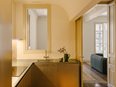
The structure of the house, with its load-bearing walls and Catalan vaulting, has been carefully preserved without alteration to maintain its identity and to keep the high ceilings with plaster moldings and the original hydraulic floors, which have been respectfully restored. The entrance is through the original hallway, which acts as a distributor to the various rooms of the house accessed through solid pine wood doors that we restored. Thus, in terms of distribution, the most significant intervention has been opening the kitchen towards the hallway and the rest of the apartment. This action has allowed for smoother circulation and created cross-views from the center of the apartment (the darker area) to the exterior and the rest of the house (the brighter area), increasing the sense of space, brightness, and visual amplitude. To reinforce this feeling, a window has been created that connects the space with the living room, which is also symmetrical with the existing kitchen window that faces the interior patio. The ceiling of the kitchen, the only new feature, with its vaulted design, evokes the classic and modernist essence of the building, integrating harmoniously with the style of the apartment. This kitchen has been conceived with a contemporary design while being respectful of historical elements. Thus, it is made of steel, with red Alicante marble fronts and flooring, and cherry wood shelves—noble materials that add warmth and harmony and that dialogue with the rest of the apartment and its historical character. Our aim was for the new elements to coexist with the originals without confronting each other, allowing the old and the new to coexist and relate to each other, enhancing one another. This intervention clearly summarizes our project proposal, in which the kitchen, previously dark and closed, transforms into an open, bright, and vital space for everyday life. In the bathrooms, we followed the same philosophy of blending the old and the artisanal. We designed custom sinks in marble, unique pieces that aim to highlight the importance of the bathing ritual, a space that transcends the everyday function to become a special and significant place. These handmade sinks emphasize craftsmanship, as was done at the time the building was constructed, allowing tradition to remain alive in every design detail. The bathrooms in this apartment are designed to visually integrate with the rest of the house, moving away from the traditional idea of hermetic and isolated spaces. When not in use, the doors remain open, contributing to a greater sense of spaciousness and improving overall lighting. For us, it is essential what is perceived through those open doors, as the bathrooms are framed and visible from the hallway and other areas of the apartment. In this way, all spaces interact, generating a visual and spatial connection that reinforces the feeling of continuity. Additionally, this arrangement allows the materials used in each area to communicate, creating harmony and coherence throughout the whole. In the bedrooms, by maintaining the hydraulic floors, ceiling moldings, and original doors, there was minimal intervention, and we only sought to preserve and consolidate what existed. However, since the new owners required four bedrooms (so that all the children could occasionally sleep at home when visiting), instead of the three originally present, the main bedroom has been divided into two using a new piece of furniture that also serves as a distributor and dressing room without altering the original mosaic or the ceiling moldings.
Materials and Techniques
In the restoration, special emphasis was placed on maintaining the authenticity of the original materials. The hydraulic floors, an emblem of modernist design, have been meticulously recovered and restored. When searching various construction warehouses for missing pieces of the original hydraulic floor, the expert eye of @rajolesdebarcelona identified our hydraulic mosaics as works by Teotim Fortuny. The hydraulic tile, originating from France in the mid-19th century, was revolutionary for its design and color. Fortuny, a prominent manufacturer of hydraulic mosaics in Catalonia, founded his company in 1895 and was characterized by his intricate designs that reflected both modernist influences and traditional Catalan elements. In the newly intervened areas (bathroom and kitchen), red Alicante marble has been chosen to harmonize with the tone of the existing hydraulic mosaic. This marble, along with traditional materials and techniques such as ceramic tiles, wax glazes, and silicate paints, contributes to integrating the new with the old, always seeking balance between the past and the present. Moreover, the original doors and windows have been restored, maintaining the texture and details that characterize the building, while improving their energy efficiency with double-glazed glass.
Featured Elements
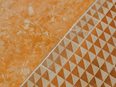
A central element of the project is the dining table, designed by the studio at the clients' request. This unique piece is constructed with a marine plywood structure cut mechanically, forming a zigzag with glued joints and a 2 cm thick Roman travertine top.
[ES]
Influencia de la ubicación
El Eixample, con su rica historia y arquitectura distintiva, ha sido una fuente de inspiración crucial para este proyecto. El piso, de unos 150m2, forma parte de la casa Salvador Viladevall III, un edificio de viviendas construido en 1904 por el arquitecto Lluís de Miquel i Roca. Se trata de un ejemplo emblemático del modernismo catalán. Nuestro objetivo ha sido preservar la esencia del piso clásico del Eixample, restaurando sus elementos constructivos y añadiendo elementos contemporáneos que enriquezcan la experiencia de vivir en este histórico edificio. Es importante destacar que, una vez recibimos el encargo y visitamos varias de las viviendas del edificio (incluida la de nuestros clientes), pudimos comprobar que la totalidad de ellas fueron renovadas anteriormente sin respetar el diseño original: los suelos hidráulicos fueron cubiertos, las molduras originales se ocultaron con falsos techos y la iluminación cenital fue reemplazada por ojos de buey empotrados. Nuestra intervención y punto de partida, por lo tanto, se ha enfocó en recuperar y preservar la esencia original del edificio, adaptándola al estilo de vida actual pero manteniendo la autenticidad del diseño modernista.
Distribución y renovación
La estructura de la casa, con sus muros de carga y forjados de bovedilla catalana, ha sido cuidadosamente preservada sin querer alterarla para conservar su identidad y poder mantener los techos altos con molduras de escayola y los suelos hidráulicos originales, respetándolos y restaurándolos con esmero. La entrada se realiza a través del pasillo original que actúa como distribuidor de las distintas habitaciones de la casa a las que se accede mediante puertas macizas de madera de pino pintado que restauramos. Por lo tanto, a nivel de distribución, la intervención más significativa ha sido la apertura de la cocina hacia el pasillo y el resto de la vivienda. Esta acción, ha permitido una circulación más fluida y ha creado vistas cruzadas entre el centro de la vivienda (y parte más oscura) hacia el exterior y el resto de la casa (la parte con más luz natural), aumentando la sensación de espacio, luminosidad e amplitud visual.
Para reforzar esta sensación, se ha realizado una apertura (ventana) que comunica el espacio con el salón y que a su vez, es simétrica con la ya existente ventana de la cocina que da al patio interior. El techo de la cocina, el único nuevo que se ha realizado, con su diseño abovedado, evoca la esencia clásica y modernista del edificio, integrándose armoniosamente con el estilo de la vivienda. Esta cocina ha sido concebida con un diseño contemporáneo pero respetuoso con los elementos históricos. Es por esto que está realizada en acero, con frontales y pavimento en mármol rojo Alicante, y estantes de madera de cerezo, materiales nobles que aportan calidez y armonía y que a su vez dialogan con el resto de la vivienda y su carácter histórico. Nuestro objetivo ha sido que los nuevos elementos convivan con los originales sin confrontarse, logrando que lo antiguo y lo nuevo coexistan y se relacionen entre sí, potenciándose mutuamente. Esta intervención resume claramente nuestra propuesta proyectual, en la que las cocina, antes oscura y cerrada, se transforma en un espacio abierto, luminoso y vital para la vida cotidiana. En los baños, hemos seguido la misma filosofía de fusión entre lo antiguo y lo artesanal. Diseñamos picas a medida en mármol, piezas únicas que buscan resaltar la importancia del ritual del baño, un espacio que trasciende la función cotidiana para convertirse en un lugar especial y significativo. Estas picas, hechas a mano, enfatizan la artesanía, tal como se hacía en el momento de la construcción del edificio, permitiendo que la tradición siga viva en cada detalle del diseño. Los baños de esta vivienda están diseñados para integrarse visualmente con el resto de la casa, dejando atrás la idea tradicional de espacios herméticos y aislados. Cuando no se utilizan, las puertas permanecen abiertas, lo que contribuye a una mayor sensación de amplitud y mejora la iluminación general. Para nosotros, es esencial lo que se percibe a través de esas puertas abiertas, ya que los baños quedan enmarcados y son visibles desde el pasillo y otras áreas de la casa. De esta manera, todos los espacios interactúan entre sí, generando una conexión visual y espacial que refuerza la sensación de continuidad. Además, esta disposición permite que los materiales empleados en cada ambiente dialoguen, creando armonía y coherencia en todo el conjunto. En los dormitorios, al mantener suelos hidráulicos, molduras de techo y puertas originales, apenas se ha intervenido y únicamente se ha buscado preservar y consolidar lo existente. Sin embargo, como la necesidad programática de los nuevos propietarios era disponer de 4 dormitorios (para que puntualmente todos los hijos puedan dormir en casa cuando están de visita), en lugar de los 3 de los que originariamente disponía la casa, se ha dividido el dormitorio principal en dos, mediante un nuevo mueble que a su vez realiza las funciones de distribuidor y vestidor, sin alterar el mosaico original ni las molduras del techo.
Materiales y técnicas
En la restauración, se ha puesto un especial énfasis en mantener la autenticidad de los materiales originales. Los suelos hidráulicos, un emblema del diseño modernista, han sido recuperados y restaurados meticulosamente. Cuando buscábamos por distintos almacenes de construcción piezas que nos faltaban del suelo hidráulico orignial, el ojo experto de @rajolesdebarcelona identificó nuestros mosaicos hidráulicos como obra de Teotim Fortuny. La baldosa hidráulica, originaria de Francia a mediados del siglo XIX, fue revolucionaria por su diseño y colorido. Fortuny, destacado fabricante de mosaicos hidráulicos en Cataluña, fundó su propia empresa en 1895 y se caracterizó por sus diseños intrincados que reflejaban tanto la influencia modernista como elementos tradicionales catalanes. En las zonas de nueva intervención (baño y cocina), se ha elegido el mármol rojo Alicante en armonía con el tono del mosaico hidráulico existente. Este mármol, junto con materiales y técnicas tradicionales como baldosas cerámicas, veladuras de cera y pinturas al silicato, contribuye a la integración de lo nuevo con lo antiguo, buscando siempre el equilibrio entre el pasado y el presente. Además, se han restaurado las puertas y ventanas originales, manteniendo la textura y los detalles que caracterizan el edificio, mientras se ha mejorado su eficiencia energética con vidrio de cámara.
Elementos destacados
Un elemento central del proyecto es la mesa del comedor, diseñada por el estudio a petición de los clientes. Esta pieza única, está construida con una estructura de tablero marino cortada mecánicamente, formando un zigzag con encajes encolados y un sobre de travertino romano de 2 cm de grosor.
Photography: Marta Vidal (https://www.martavidal.com/)
38 users love this project
Enlarge image


Influence of the Location Eixample, with its rich history and distinctive architecture, has been a crucial source of inspiration for this project. The apartment, approximately 150m², is part of the Casa Salvador Viladevall III, a residential building built in 1904 by architect Lluís de Miquel i Roca. It is an emblematic example of Catalan modernism. Our goal has been to preserve the essence of the classic Eixample apartment by restoring its construction elements and adding...
- Year 2024
- Work finished in 2024
- Client Bernat Riera and Sergi Puig
- Status Completed works
- Type Apartments / Interior design / Building Recovery and Renewal


comment