
Lavra House | WER Studio
Matosinhos Municipality / Portugal / 2022
73
Situated on a lot commonly referred to as a "terreno de gaveta" in Portuguese, this type of site is characterized by being narrow and deep, typically sandwiched between neighboring buildings with limited frontage. The plot in question measures 10 meters by 18 meters, totaling 180 square meters. Given the small size, it was a significant challenge to ensure privacy from the street and the closely adjacent neighboring properties.
The house itself spans 184 square meters of construction, with an additional 70 square meters on the rooftop. To ensure privacy while maximizing the beautiful coastal views, the design strategically inverts the traditional program organization: the private areas are located on the ground floor, with bedrooms and an office facing a central courtyard, while the social areas occupy the upper floors, creating a visual and functional separation from the street.
The staircase serves as the central element of vertical circulation, connecting all floors and fostering visual permeability between them. On the ground floor, the same exterior floor treatment defines a masonry volume, featuring steps made from clay bricks. In the upper levels, vertical steel cables extend the entire length of the staircase, supporting floating steps anchored to the wall.
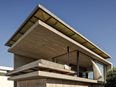
The house’s structure is a mix of concrete and steel, materials which also appear prominently in various other architectural details such as the bathroom partitions and stair finishes. The design draws on several modernist influences from São Paulo, particularly in its proportions, verticality, and rhythmic arrangement of horizontally oriented volumes. The exposed concrete ceilings were meticulously treated, with the formwork pattern—designed by the architects—creating a refined finish. Every detail, from the placement of light fixtures to the integration of embedded systems, was carefully planned in advance. Curtain tracks have been strategically embedded in the concrete slab during the formwork stage.
The expansive aluminum and glass frames highlight the view and maximize the abundant natural light while allowing the breeze to flow freely. This solution enhances energy efficiency by reducing the reliance on artificial lighting and cooling systems throughout the day.
The house seamlessly blurs the line between interior and exterior, a key concept of the design. The architect's vision was to expand the interior boundaries, creating an effortless transition that makes outdoor living an integral part of the home's experience. This is further emphasized by the use of materials traditionally applied to exterior spaces, which were incorporated into the interior design.
The social spaces are extended by large overhangs with built-in benches that serve as guardrails, giving a sense of expansion and fluidity to the living areas. The kitchen, designed to accommodate social gatherings, is centered around an island, allowing for easy circulation and interaction during meal preparation.
The décor features existing furniture from the family’s collection, along with pieces finished in wood and rattan, all aiming for a relaxed simplicity. Storage spaces were discreetly integrated into the staircase area, with custom-designed panels that blend seamlessly with the surrounding architecture.
The bedrooms are equipped with wooden panels that provide complete blackout and privacy, extending across the exterior of the ground floor. The brise-soleil is made from Accoya, a type of wood modified through acetylation. This process increases its resistance to moisture absorption and enhances its durability against the elements.
In the bedrooms, a soft color palette creates a comforting atmosphere. The bathrooms feature metal doors with textured glass closures.
In the office, defined as an extension of the main volume, the glass frames and skylight provide continuous natural light throughout the day, accentuating the textures of the flooring. The cabinetry features panels that mimic the cabinets, creating a seamless surface. The central table, supported by a single leg, maintains an overhanging base, contributing to its aesthetic and visual lightness.
The house is intentionally shielded from the strong northern winds typical in Northern Portugal, allowing it to remain open and breezy even on windy days. The open terrace on the rooftop has a built-in pool, protected from the wind and opened to the reserved green area along the beach.
To facilitate cross-ventilation, a small window opening on the terrace, combined with one at ground level, quickly cools the house without the need for mechanical air conditioning. However, for colder months, the house is equipped with underfloor heating throughout most rooms, ensuring comfort and energy efficiency.
Project: Lavra House
Location: Matosinhos, Portugal
Project Year: 2018
Conclusion Year: 2022
Plot Area: 180m²
Built Area: 184m²
Architecture: WER Studio
Interior Design: WER Studio
Author: Marina Werfel
Design Team: André Pinto, Carolina Mota
Landscape Design: Sara Sall
Text/Communication: Matheus Pereira
Photos: Fran Parente
Suppliers: So Soares, Sika, Astro Lightning, Kreon Lightning, Vale de Gandara, Tecno Deck, Banema, Aleluia Ceramics, Bruma, Moab 80, Hisbalit, Corian, Aldeco, HavWoods, Caipirib, HK Living
73 users love this project
Enlarge image


Situated on a lot commonly referred to as a "terreno de gaveta" in Portuguese, this type of site is characterized by being narrow and deep, typically sandwiched between neighboring buildings with limited frontage. The plot in question measures 10 meters by 18 meters, totaling 180 square meters. Given the small size, it was a significant challenge to ensure privacy from the street and the closely adjacent neighboring properties. The house itself spans 184 square meters of construction, with an...
- Year 2022
- Work started in 2018
- Work finished in 2022
- Main structure Reinforced concrete
- Client Private
- Status Completed works
- Type Single-family residence
- Websitehttps://studiower.com/houselavra/

comment