
House Between Tracks and Gardens | Balissat Kaçani
Baden bei Wien / Austria / 2024
19
Balissat Kaçani in collaboration with Jann Erhard.
Next to the tracks of the Badener Bahn and behind a former industrialist's villa, the house occupies a plot between the tram and a garden being introverted and exposed at the same time.
Along the curve of the tram tracks, lined with tall, old trees, a private path tangentially accesses an almost square shaped and segregated section of the formerly large garden of an industrialist’s villa. The front façade of the newly built house marks the end of this path. On one side, the house is in close proximity to the tracks. On the other side, a wall encloses a garden and defines it as an autonomous space shielded from the outside world. This garden forms the conceptual counterpart to the traffic infrastructure and can only be reached and perceived through the house. The house appears to occupy a narrow plot between the tracks and walls.
Dividing and connecting at the same time, the house mediates between the garden and the infrastructure.
The house is constructed with a 55 cm thick exterior wall made of insulating concrete. This seemingly archaic construction method is open to diffusion and has no layers. It is the same in the interior as in the exterior. All interior walls and ceilings are made of 15 cm thick reinforced concrete. The pipes for heating in winter and cooling in summer are laid directly into the floor slabs, without any additional surface constructions.
The entire house is a monolithic, thermally activated mass.
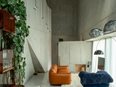
In a gap between the house and the wall, the garden wall folds into the building and defines the entrance. The interior space behind it extends over the entire half of the house facing away from the tracks. Behind the folded-in wall, the space opens up to the garden on its long side. With its dimensions of more than 10 meters high, almost 12 meters long and barely more than 3 meters wide, it forms an empty half.
The garden space is constructively as well as phenomenologically perceived as both an interior and an exterior space.
This large room forms the starting point for two staircases. One is located centrally, the other peripherally. Twisted into each other like a double helix, they access the second, full half of the house with six rooms on three floors orienting towards the tracks.
Each of these rooms has the same floor area and proportions, a large fixed glazed window facing the tracks in the north and a door opening away from the noise for ventilation. The different lengths of the staircases generate different heights for these otherwise identical spaces, subtly differentiating them.
The connections with and relationships to each other qualify the quantitatively similar spaces.
The two staircases provide access to two independent, unconnected parts. From the entrance area, the peripheral staircase leads to two rooms one after the other, half a storey apart. The central staircase leads through a room to another room at the top of the house. Although all these rooms are located above and next to each other, they are perceived as being very distant from one another. By interlocking the staircases, both parts reach all four sides and extend over all three storeys of the house.
The house is experienced in a fragmented way, but always perceived as a whole.
The specific spatial qualities create unpredictable and diverse possibilities for the appropriation of the use-neutral rooms and thus simultaneously react to life circumstances that have almost passed or that may never occur.
DE
Neben den Gleisen der Badener Bahn und hinter einer ehemaligen Fabrikantenvilla besetzt das Haus eine ebenso introvertierte wie exponierte Parzelle zwischen Tram und Garten.
Entlang der Kurve der Tramgleise, gesäumt von hohen, alten Bäumen erschliesst ein privater Weg tangential einen fast quadratisch ausparzellierten Teil des vormals grossen Gartens einer Fabrikantenvilla. Das neue Haus markiert mit seiner Stirnfassade das Ende dieses Weges. Auf der einen Seite rückt das Haus in unmittelbare Nähe der Gleise. Auf der Anderen umfasst eine Mauer einen Garten und definiert diesen als autonomen, von der Aussenwelt abgeschirmten Raum. Dieser Garten bildet das konzeptionelle Gegenstück zur Verkehrsinfrastruktur und kann nur über das Haus erreicht und wahrgenommen werden. Das Haus scheint eine schmale Parzelle zwischen Gleisen und Mauern zu besetzen.
Teilend und verbindend zugleich vermittelt das Haus zwischen Garten und Infrastruktur.
Das Haus besteht aus einer 55 cm dicken Aussenwand aus Dämmbeton. Diese archaisch anmutende Bauweise ist diffusionsoffen und besitzt keine Schichten. Sie ist von Innen und Aussen gleich. Alle inneren Wände und Decken bestehen aus 15 cm dünnem Stahlbeton. Die Rohre für die Heizung im Winter und die Kühlung im Sommer werden direkt in die Bodenplatten eingelegt, ohne zusätzliche Aufbauten.
Das ganze Haus ist eine monolithische, thermisch aktivierte Masse und wirkt temperaturregulierend.
In einer Fuge zwischen Haus und Mauer faltet sich die Gartenmauer als Wand ins Gebäude und definiert den Zugang. Der dahinter liegende Innenraum dehnt sich über die gesamte, den Gleisen abgewandte Hälfte des Hauses aus. Hinter der hinein gefalteten Wand öffnet er sich längs zum Garten. Mit seinen Dimensionen von mehr als 10 Metern Höhe, fast 12 Metern Länge und kaum mehr als 3 Metern Breite bildet er eine leere Hälfte.
Der Gartenraum wirkt konstruktiv und räumlich als Innen- wie als Aussenraum. Er ist sowohl Teil des Hauses als auch Teil des Gartens.
Dieser grosse Raum bildet den Ausgangspunkt für zwei Treppen. Die eine liegt zentral, die andere peripher. Als Doppelhelix ineinander verdreht, erschliessen sie die zweite, volle Hälfte des Hauses, in der sich sechs Räume auf drei Geschossen zu den Gleisen hin orientieren. Jeder dieser Räume besitzt die gleiche Grundfläche, ein grosses festverglastes Fenster nach Norden zu den Gleisen und eine dem Lärm abgewandte Tür zum Lüften. Die unterschiedlichen Längen der Treppenläufe generieren verschiedene Raumhöhen für diese sonst gleichen Räume und sorgen für eine subtile Differenzierung.
Die Verbindungen mit- und Beziehungen zueinander qualifizieren die quantitativ gleichartigen Räume.
Die beiden Treppen erschliessen zwei unabhängige, nicht miteinander verbundene Teile. Aus dem Eingangsbereich führt die periphere Treppe nacheinander, ein halbes Geschoss zueinander versetzt, zu zwei Zimmern. Die zentrale Treppe führt durch ein Zimmer hindurch zu einem Zimmer zuoberst im Haus. Obwohl sich all diese Räume über- und nebeneinander befinden, werden sie als maximal voneinander entfernt wahrgenommen. Durch die Verschränkung der Treppen stossen beide Teile an alle vier Seiten und erstrecken sich über alle vier Geschosse.
Trotz Trennung wird das Haus zwar fragmentarisch erlebt, aber immer als Ganzes wahrgenommen.
Die spezifischen räumlichen Qualitäten schaffen unvorhersehbare und vielfältige Möglichkeiten der Aneignung der nutzungsneutralen Zimmer und reagiert so gleichzeitig auf bereits fast vergangene oder möglicherweise nie eintretende Lebensumstände.
19 users love this project
Enlarge image



Balissat Kaçani in collaboration with Jann Erhard. Next to the tracks of the Badener Bahn and behind a former industrialist's villa, the house occupies a plot between the tram and a garden being introverted and exposed at the same time. Along the curve of the tram tracks, lined with tall, old trees, a private path tangentially accesses an almost square shaped and segregated section of the formerly large garden of an industrialist’s villa. The front façade of...
- Year 2024
- Work finished in 2024
- Status Completed works
- Type Single-family residence

comment