
Apartment on Księcia Józefa Street in Krakow | one desk
Appartamento in via księcia Józefa a Cracovia Kraków / Poland / 2025
19
The apartment is located in an intimate building in Kraków’s Zwierzyniec district. Positioned on the top floor with southern exposure, the space feels suspended above the treetops, offering an open view across the unbounded Vistula River valley. To the north, the scenery is equally spectacular – the Przegorzały Castle, masterfully integrated into the green slope of the Wolski Forest by the pre-war modernist architect Adolf Szyszko-Bohusz.
The owners, who relocated to Kraków from the Tricity area situated on the Baltic coast, defined a modest functional program consisting of three essential elements: a living area, a bathroom, and one bedroom. The space was meant to remain open and filled with daylight. What initially seemed a straightforward task was complicated by the complex geometry of the multi-pitched roof covering the top floor. The sloping ceilings, present in every room, sometimes proved to be allies, at other times – a real challenge.
In the northern part of the apartment, where two smaller rooms were originally located, a single, spacious bedroom was created, complete with a wardrobe and a small workspace. One wall is lined with light blue built-in cabinetry that transitions into a small bookcase, visually unified by a horizontal “cornice” in the same hue. On one side, mirrored doors lead to the wardrobe; on the other, a built-in seat finished with veneer designed by Ettore Sottsass organizes the irregularities created by merging two former rooms. The bedroom opens onto the hall and living area through wide, double doors with fluted glass. This generous opening enhances the sense of continuity and connects two remarkable views – of the Vistula valley and the Wolski Forest. The feeling of spatial continuum is achieved primarily through a seamless, light microcement floor, while a mirrored wall in the entrance hall conceals the bathroom door and amplifies the perception of space, adding a slightly surreal touch – like the first sentence of a novel, inviting the reader further into the story.
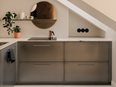
The owners wanted the interior to remain calm and bright. Most walls were treated with restraint, allowing the pale surfaces to adapt and transform under changing light. The low kitchen cabinetry follows this same principle: stainless steel fronts and a light stone countertop subtly reflect the surroundings and fragments of light. The serene tonality is broken by a few deliberate accents, the most striking of which is the tall kitchen unit – a semi–freestanding volume finished entirely in chocolate bird’s-eye maple. Its softly rounded edge recalls the streamlined forms of 1930s Gdynia modernism – a quiet nod to the owners’ seaside origins. A similar motif appears in the bedroom, where part of the built-in furniture forms a gentle transition between functional zones.
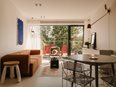
The living area opens fully onto a large terrace filled with potted plants. Apart from the rust-colored sofa, key elements include a custom-made sideboard and the Counterbalance wall lamp by Luceplan, illuminating the dining table.
The bathroom, like the rest of the interior, is defined by a bright palette in which white is expressed through various textures and shades. The shower enclosure and countertop are finished with small Vogue Ceramica tiles. A technical niche housing the washer and dryer is hidden behind a cream-colored curtain, matching the tone of the walls and built-in furniture. Against this light backdrop, the under-sink cabinet in warm, reddish bird’s-eye veneer stands out.
In this ornament-free interior, there is room for contemporary art. Above the bed hangs a painting by Karolina Wasiluk; on the opposite wall, a work by Kraków-based artist Michał Sroka. In the living room, a striking painting by Aleksandra Toborowicz completes the composition.
Photos: Zasoby Studio
L’appartamento si trova in un edificio intimo nel quartiere Zwierzyniec di Cracovia. Situato all’ultimo piano con esposizione a sud, lo spazio sembra sospeso sopra le chiome degli alberi, offrendo una vista aperta sulla sconfinata valle del fiume Vistola. A nord, lo scenario è altrettanto spettacolare: il castello di Przegorzały, magistralmente integrato nel pendio verde del Bosco Wolski dall’architetto modernista prebellico Adolf Szyszko-Bohusz.
I proprietari, trasferitisi a Cracovia dall’area della Tripla Città, situata sulla costa baltica, hanno definito un programma funzionale modesto, composto da tre elementi essenziali: una zona giorno, un bagno e una camera da letto. Lo spazio doveva rimanere aperto e pieno di luce naturale. Ciò che inizialmente sembrava un compito semplice è stato complicato dalla geometria complessa del tetto a più falde che copre l’ultimo piano. I soffitti inclinati, presenti in ogni stanza, a volte si sono rivelati alleati, altre volte – una vera sfida.
Nella parte settentrionale dell’appartamento, dove originariamente si trovavano due stanze più piccole, è stata creata un’unica e ampia camera da letto, completa di guardaroba e un piccolo spazio di lavoro. Una parete è rivestita da armadiature su misura azzurro chiaro che si trasformano in una piccola libreria, unificate visivamente da una “cornice” orizzontale nella stessa tonalità. Da un lato, porte specchiate conducono al guardaroba; dall’altro, una seduta integrata rifinita in impiallacciatura disegnata da Ettore Sottsass organizza le irregolarità create dall’unione delle due stanze precedenti. La camera da letto si apre sull’ingresso e sulla zona giorno attraverso ampie porte a doppio battente con vetro scanalato. Questa generosa apertura amplifica il senso di continuità e collega due vedute straordinarie – la valle della Vistola e il Bosco Wolski. La sensazione di continuum spaziale è ottenuta soprattutto grazie a un pavimento continuo in microcemento chiaro, mentre una parete specchiata nell’ingresso nasconde la porta del bagno e amplifica la percezione dello spazio, aggiungendo un tocco leggermente surreale – come la prima frase di un romanzo, che invita il lettore ad addentrarsi nella storia.
I proprietari desideravano che l’interno rimanesse calmo e luminoso. La maggior parte delle pareti è trattata con sobrietà, permettendo alle superfici pallide di adattarsi e trasformarsi sotto la luce mutevole. Le basse armadiature della cucina seguono lo stesso principio: frontali in acciaio inox e un piano in pietra chiara riflettono delicatamente l’ambiente e frammenti di luce. La tonalità serena è interrotta da pochi accenti mirati, il più evidente dei quali è il grande modulo cucina – un volume semi-indipendente interamente rivestito in acero occhiolinato color cioccolato. Il suo bordo dolcemente arrotondato richiama le forme aerodinamiche del modernismo di Gdynia degli anni ’30 – un discreto omaggio alle origini marittime dei proprietari. Un motivo simile ricorre nella camera da letto, dove una parte dell’arredo su misura crea una transizione morbida tra le diverse zone funzionali.
La zona giorno si apre completamente su un ampio terrazzo pieno di piante in vaso. Oltre al divano color ruggine, gli elementi principali includono una madia realizzata su misura e la lampada da parete Counterbalance di Luceplan, che illumina il tavolo da pranzo.
Il bagno, come il resto dell’interno, è definito da una palette chiara in cui il bianco si esprime attraverso diverse texture e tonalità. Il box doccia e il piano del lavabo sono rifiniti con piccole piastrelle Vogue Ceramica. Una nicchia tecnica che ospita lavatrice e asciugatrice è nascosta dietro una tenda color crema, in armonia con le pareti e l’arredo su misura. Su questo sfondo luminoso risalta il mobile sotto lavabo, in impiallacciatura occhiolinata dalle calde tonalità rossastre.
In questo interno privo di ornamenti c’è spazio per l’arte contemporanea. Sopra il letto è appeso un dipinto di Karolina Wasiluk; sulla parete opposta, un’opera dell’artista cracoviano Michał Sroka. Nel soggiorno, un suggestivo dipinto di Aleksandra Toborowicz completa la composizione.
Fotografie: Zasoby Studio
19 users love this project
Enlarge image


The apartment is located in an intimate building in Kraków’s Zwierzyniec district. Positioned on the top floor with southern exposure, the space feels suspended above the treetops, offering an open view across the unbounded Vistula River valley. To the north, the scenery is equally spectacular – the Przegorzały Castle, masterfully integrated into the green slope of the Wolski Forest by the pre-war modernist architect Adolf Szyszko-Bohusz. The owners, who relocated to...
- Year 2025
- Work started in 2024
- Work finished in 2025
- Total area 76 m²
- Status Completed works
- Type Apartments
- Websitehttps://www.whitemad.pl/mieszkanie-w-krakowie-wnetrze-spodoba-sie-fanom-designu/
- Websitehttps://label-magazine.com/wnetrza/artykuly/skomplikowana-geometria-skosow-i-lustrzane-iluzje-w-krakowskim-mieszkaniu-od-one-desk

comment