
Casa Corten | HPA Arquitetura e Investimentos
Corten House Braga / Portugal / 2025
7
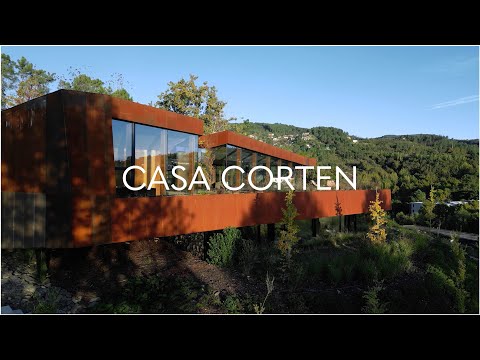
The Casa Corten project emerged from a contextual and site-specific response to the pre-existing conditions of the plot — a former timber factory, now in ruins, with only oxidized steel sheets remaining as traces of its industrial past. The architectural form and layout were meticulously defined in accordance with the site's topography, employing a fragmented volumetry that aligns with the natural contours of the land, thereby minimizing the visual and physical impact of the intervention on the terrain and its surrounding landscape.
Two key design challenges were the steep natural slope and the solar orientation. The slope was addressed through the implementation of green roofs on both levels, enabling the built volumes to be perceived as extensions of the terrain — almost like sculpted elevations — which foster a sense of natural integration. To address the east-facing orientation and its inverse solar exposure, the main openings were oriented westward, allowing for passive solar gains. The architectural gesture of “lifting” the house from the ground plane also allowed natural light to penetrate the lower level while preserving the existing native vegetation. Thus, the garden becomes the spatial and conceptual core of the project, connecting both levels and transforming a constraint into a defining feature.
The upper floor is recessed, following the topographical line, which breaks the massing and introduces greater privacy from the adjacent path. Fully glazed façades enhance the relationship between interior and landscape, ensuring continuous daylight and panoramic views. The southern façade is screened with a perforated corten steel brise-soleil, which functions both as a sun-shading device and a visual filter, providing privacy on the most exposed elevation while contributing to the material identity of the building.
Material selection was guided by a commitment to contextual sensitivity and continuity with the site’s past. Corten steel clads the exterior envelope and penetrates the interior at key moments — notably the entrance hall and suites — where it is juxtaposed with raw, irregularly textured, naturally stained concrete. This material palette establishes a tactile and chromatic dialogue that embraces imperfection and authenticity.
Internally, the spatial organization emphasizes openness, light, and a constant visual connection with the natural surroundings. The entrance hall, clad in corten and wood, acts as a vertical connector between the private area on the lower level and the social areas above. Exposed concrete dominates floors, walls, and ceilings, reinforcing spatial cohesion and material continuity. The lower level accommodates four suites, while the upper level houses the kitchen, dining, and living areas under a dynamic, high-pitched roof structure that opens up to 360-degree views of the landscape.
All built-in furniture was custom-designed, and decorative elements were carefully curated to reinforce architectural intent.
Sustainability and environmental performance were central to the design strategy. Features such as extensive green roofs, rainwater harvesting systems, photovoltaic panels, deciduous vegetation for passive shading, strategically planted trees, and integrated home automation contribute to a highly energy-efficient and environmentally responsive dwelling.
The external areas were conceived as extensions of the interior, fostering a seamless indoor-outdoor experience. They include a series of patios, a garden populated with native and aromatic species, an accessible green roof for relaxation and contemplation, an outdoor kitchen with wood-fired oven, an exterior fireplace, a heated jacuzzi, and an infinity pool set within a naturalistic pond and landscape. Together, these elements create a unique living environment that balances social interaction with tranquility and immersive contact with nature.
[PT]
O projeto da Casa Corten foi concebido a partir de uma leitura sensível e contextualizada do local, anteriormente ocupado por uma antiga unidade fabril de madeira, hoje em ruínas, da qual apenas sobraram vestígios de chapas metálicas oxidadas. A implantação e volumetria do edifício foram cuidadosamente articuladas com as curvas de nível do terreno, permitindo uma integração topográfica natural e uma minimização do impacto da construção na morfologia e paisagem envolvente.
A acentuada inclinação do terreno e a desfavorável orientação solar constituíram desafios determinantes na execução do projeto. A resposta à pendente pronunciada consistiu na adoção de coberturas ajardinadas em ambos os pisos, permitindo que estas sejam percecionadas como prolongamentos do solo – quase alçados – integrando visualmente o edifício na paisagem e promovendo um efeito de naturalização da volumetria. No que respeita à orientação solar, o volume foi estrategicamente deslocado no sentido oposto à inclinação, como se estivesse a “emergir da terra”, permitindo a entrada de luz natural no piso inferior e garantindo simultaneamente a preservação da vegetação autóctone existente. A abertura a poente foi uma solução intencional para potenciar os ganhos solares e reforçar a presença do jardim enquanto elemento central e elo de ligação dos dois pisos.
O piso superior, mais recuado, acompanha a morfologia do terreno, contribuindo para a fragmentação volumétrica do edifício e garantindo maior privacidade face ao caminho contíguo. As fachadas envidraçadas maximizam a permeabilidade visual com a envolvente e promovem a entrada abundante de luz natural. A fachada sul é protegida por um filtro metálico em chapa perfurada de aço corten, que assegura sombreamento, controlo solar passivo e privacidade, atuando como uma segunda pele do edifício.
A seleção dos materiais assentou numa lógica de continuidade com a pré-existência e de integração visual com o contexto natural. O aço corten reveste a envolvente exterior e estende-se para o interior nos espaços de transição, como o hall de entrada e as suítes. Este material, em conjunto com o betão aparente de textura irregular e pigmentação natural, cria uma paleta de texturas imperfeitas, conferindo identidade e autenticidade ao espaço.
No interior, os ambientes são amplos, fluidos e permanentemente relacionados com a natureza circundante. O hall de entrada, revestido em madeira e aço corten, organiza a distribuição funcional entre as zonas privadas (piso inferior) e sociais (piso superior). O betão aparente reveste integralmente paredes, tetos e pavimentos, reforçando a materialidade do espaço. O piso inferior alberga as quatro suítes, enquanto o piso superior abriga a zona social – cozinha, sala de jantar e sala de estar – marcada por um pé-direito generoso, cobertura inclinada e vista panorâmica a 360 graus.
As peças do mobiliário existente foram desenhadas à medida e os elementos decorativos foram criteriosamente escolhidas e enquadrados na arquitetura da casa.
Do ponto de vista ambiental, a habitação adota uma abordagem sustentável e eficiente: coberturas ajardinadas, recolha e aproveitamento de águas pluviais, painéis fotovoltaicos, vegetação caduca para sombreamento sazonal e um sistema de domótica integrado, asseguram elevados níveis de desempenho energético e conforto.
O espaço exterior prolonga a lógica de integração paisagística, incorporando pátios, jardim com espécies autóctones e aromáticas, cobertura acessível para lazer e meditação, zona de churrasqueira com forno a lenha, lareira exterior, jacuzzi aquecido e uma piscina infinita rodeada por lago e jardim natural. Este conjunto de elementos proporciona uma vivência exterior rica, equilibrando momentos de convívio com espaços de introspeção e contemplação da natureza.
Photography: Ivo Tavares
7 users love this project
Enlarge image


The Casa Corten project emerged from a contextual and site-specific response to the pre-existing conditions of the plot — a former timber factory, now in ruins, with only oxidized steel sheets remaining as traces of its industrial past. The architectural form and layout were meticulously defined in accordance with the site's topography, employing a fragmented volumetry that aligns with the natural contours of the land, thereby minimizing the visual and physical impact of the intervention...
- Year 2025
- Work finished in 2025
- Status Completed works
- Type Single-family residence / Interior design / Adaptive reuse

comment