

The restoration of a major UK landmark, the launch of an advanced medical research centre, and the creation of a modern almshouse aimed at combating isolation among the elderly are three of the six projects shortlisted for the 2025 RIBA Stirling Prize. Joining them on the shortlist are a university’s “fashion factory,” an accessible home, and a bold extension to a family house.
The Stirling Prize, awarded annually by the Royal Institute of British Architects (RIBA), is widely regarded as the UK’s most prestigious architecture award. It recognises the building judged to have made the greatest contribution to architecture that year, with judges assessing design vision, creativity, originality, accessibility, sustainability, and how well each project serves its purpose while delighting those who use it.
Launched in 1966, the RIBA Awards celebrate the very best of British architecture. From small-scale homes to major public landmarks, winning projects set the benchmark for design excellence. Eligible entries must be located in the UK and designed by RIBA Chartered Architects or RIBA International Fellows.
The six projects in the running for the 2025 UK’s highest accolade in architecture, are:
Appleby Blue Almshouse by Witherford Watson Mann Architects
Ph. ©Philip Vile
A pioneering model providing housing for later living: Replacing an abandoned care home, Appleby Blue radically reimagines the traditional almshouse to foster community and reduce isolation among residents. The layout flips a centuries-old typology, placing communal spaces at its heart to encourage interaction, while bay windows at street level connect residents to the outside world. Thoughtful details, such as the timber-clad interior, discreet accessibility features and terracotta paved hallways bursting with benches and planters, aim to deinstitutionalise the typical model of older people’s housing. The result is a new standard for inclusive social housing in later life.
Ph. ©House of Commons
Preservation of a national monument: Housing the symbolic ‘Big Ben’ bell – the timepiece of the nation, the most comprehensive restoration of Elizabeth Tower in 160 years is a conservation masterpiece. Traditional materials and bespoke craftspeople were sourced from across the UK to honour the Tower’s original design, rectifying previous restoration missteps and repairing newly uncovered damage from the Second World War. Careful details, such as reinstating the Victorian colour scheme on the clock faces and reintroducing the St George’s Cross, return the tower to its former glory. Subtle improvements to accessibility, including a new visitor lift, have also opened up the monument to a broader audience for the first time.
Hastings House by Hugh Strange Architects
Ph. ©Rory Gaylor
An inventive home extension: Instead of demolishing an ageing hillside home, Hastings House reuses and celebrates the existing structure and materials to create a house of contrasts. A restrained, updated Victorian front gives way to a modern, timber framed rear, while a rough concrete courtyard celebrates its industrial character. A series of stitched extensions step up the hillside, blending inside and outside to cleverly create light-filled, open spaces. The result goes beyond a house extension, transforming the entire home and producing a lesson in restrained, inventive reuse.
London College of Fashion by Allies & Morrison
Ph. ©Simon Menges
A vertical campus for creativity: Located in the cultural heart of the Queen Elizabeth Park in Stratford, the new home for the London College of Fashion brings together its 6,000 staff and students for the first time. A constrained site prompted a vertical campus rising to 17 storeys, with dramatic staircases unfurling through a shared “heart space” to encourage collaboration. A restrained palette of materials allows the building to act as a canvas for its occupants, while long sightlines and flexible workspaces promote adaptability. Subtle nods to the area’s industrial history create the feeling of a thriving “factory for fashion”.
Niwa House by Takero Shimazaki Architects
Ph. ©Anton Gorlenko
A blueprint for accessible housing: Meaning “Garden Home” in Japanese, Niwa House is a pavilion-like oasis built on a previously derelict South London plot. Sprawling across and downwards to navigate planning constraints, this “horizontal home” is a masterclass in craftsmanship and restraint. Subtle interventions, such as a flowing open-plan layout and integrated accessibility features create a seamless experience for its wheelchair-user resident while futureproofing it for later life, demonstrating how inclusive design can be functional yet elegant. A hybrid timber and stone structure, paired with floor to ceiling windows, bathe each room in light, while a courtyard garden rising through both floors underlines the serene sense of escapism.
The DISC | AstraZeneca Discovery Centre by Herzog & de Meuron / BDP
Ph. ©Hufton+Crow
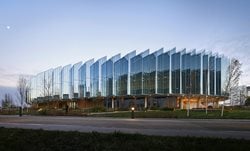
A civic laboratory: AstraZeneca’s Discovery Centre radically redefines the research facility, blending cutting-edge laboratories with welcoming public spaces. The surprisingly low-rise, sawtooth-roofed building adopts a curved triangular plan, forming an inviting interface for Cambridge’s Biomedical Cluster. At its heart, a publicly accessible courtyard echoes the city's iconic college quadrangles, one of the buildings many tributes to Cambridge’s heritage. Inside, 16 glass-lined laboratories are connected by clever interconnecting corridors that balance stringent security with transparency, putting science on display. Flexible lab stations and open-plan layouts foster innovation in a bold new prototype for research facilities.
RIBA President, Chris Williamson, said:
“These projects demonstrate architecture’s unique ability to address some of the most urgent challenges of our time, responding with creativity, adaptability and care. From a monumental civic building that champions investment in arts and culture, to the sensitive restoration of one the nation’s most iconic landmarks, and a cutting-edge medical research facility, each offers a blueprint for how architecture can enrich society.
At a time when quality housing is urgently needed across the country, the residential projects stand out for their inventive, human-centred design, from social housing that combats isolation in later life, to a bold home extension that celebrates reuse, and an accessible home that proves that beauty and accessibility can coexist.
Together, these projects offer a hopeful vision for the future, one where architecture strengthens communities and helps shape a more sustainable and inclusive built environment.”
The winner of the RIBA Stirling Prize 2025 will be announced live at London’s Roundhouse on 16 October 2025, sponsored by Autodesk.
Previous winners of the RIBA Stirling Prize include: The Elizabeth Line by Grimshaw, Maynard, Equation and AtkinsRéalis (2024); The John Morden Centre by Mæ (2023); The New Library, Magdalene College in Cambridge by Níall McLaughlin Architects (2022); Kingston University London - Town House by Grafton Architects (2021); Goldsmith Street by Mikhail Riches (2019); Bloomberg by Foster + Partners (2018); Hastings Pier by dRMM (2017); Newport Street Gallery by Caruso St John (2016); Burntwood School, London by Allford Hall Monaghan Morris (AHMM) (2015); Liverpool Everyman Theatre by Haworth Tompkins (2014); Astley Castle by Witherford Watson Mann (2013).



 0
0
 0
0
 1
1
 2
2
 1
1
 7
7
comment