

The inauguration of Techo International Airport in Phnom Penh marks a new milestone for Cambodia’s architectural and infrastructural future. Designed by Foster + Partners, the terminal captures the nation’s vision for long-term growth while embracing its cultural heritage and tropical environment.
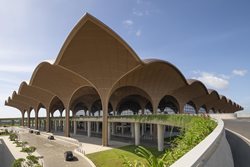
Drawing from one of the world’s oldest civilizations, the architecture combines innovation and tradition to create a building that is both contemporary and rooted in place. The terminal’s sweeping form, rich materials, and natural light embody Cambodia’s identity in a modern architectural language.
Stefan Behling, Head of Studio at Foster + Partners, described the project as “a celebration of Cambodian culture and light – forming a new gateway to the country. It is also one of the most sustainable airports in the region, filled with natural daylight and incredible local greenery, and offering strong visual connections to the outside.”
The airport, located 20 kilometers south of Phnom Penh, is organized around a central head house and two aerofoil-shaped piers. The first phase—comprising the head house and northern pier—opened to the public in September 2025, while the southern pier is expected to follow by 2030. Designed for intuitive navigation, the terminal offers short walking distances, clear sightlines, and simple orientation for passengers.
A single, undulating roof canopy unites the entire structure, stretching from drop-off to airside. Supported by monumental structural “trees,” each spanning 36 meters, the roof rises and falls like a wave, echoing the forms of Cambodia’s royal palaces and sacred temples. Beneath it, a woven soffit inspired by traditional basketry filters daylight into the vast interior. Over 180 skylights punctuate the ceiling, creating a soft interplay of light throughout the day, while warm artificial illumination transforms the space at night.
Native Romduol trees, palms, and tropical flora guide travelers through the terminal, reinforcing the connection between architecture and nature. Art and craftsmanship are deeply embedded in the design, from 200 handcrafted sculptures to a striking bronze Buddha at the heart of the space—symbols of Cambodia’s evolving cultural narrative.
Nikolai Malsch, Senior Partner at Foster + Partners, emphasized the design’s fusion of technology and tradition: “Our design blends technological innovation with references to Cambodia’s built heritage. Interior materials are warm and welcoming to ensure the highest level of passenger comfort, while reinforcing the country’s unique identity.”
Sustainability is a defining principle of the project. The terminal integrates passive design strategies to minimize energy consumption—its extended roof provides shading and reduces reliance on mechanical systems, while the natural light strategy drastically limits daytime artificial lighting.
Matthew Hayhurst, Partner at Foster + Partners, noted: “Our holistic vision encompasses the airport’s relationship with its immediate surroundings and the city. The terminal building overlooks a new public park, enhancing connections with nature and supporting general wellbeing for all passengers.”
The terminal also anchors the Techo International Airport City Masterplan, which envisions a green, transit-oriented urban hub centered on the airport. Future plans include a high-speed rail connection and a network of public spaces designed to foster a harmonious relationship between people, nature, and infrastructure.
***
Photos: ©Nigel Young / Foster + Partners


 2
2
comment