
 East River Park; credit: Iwan Baan
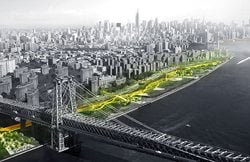
The 2.25-mile flood protection system dubbed the East Side Coastal Resiliency Project (ESCR) has reached a major milestone with the opening of key areas of East River Park. Conceived as a “parkipelago” of interconnected parks along the East River waterfront, the project creates a series of elevated green spaces that double as flood barriers while offering new public amenities for the surrounding Lower East Side neighborhood.
East River Park; credit: Iwan Baan
Stuyvesant Cove Park; credit: BIG/Jeff Tao
Developed under the leadership of the NYC Department of Design and Construction (NYCDDC) and designed by BIG | Bjarke Ingels Group, Mathews Nielsen Landscape Architects (MNLA), ONE Architecture & Urbanism, AKRF, and residents of the Lower East Side, ESCR is a $1.45 billion coastal protection initiative spanning Montgomery to East 25th Streets. Following the original 2014 BIG U vision - The Dryline - for 10 continuous miles of protective park and public realm in the wake of Superstorm Sandy, the project is designed to safeguard more than 110,000 New Yorkers from future storms and tidal flooding.
East River Park; credit: DDC/Matthew Lapiska
Located within the FEMA 100-year floodplain, ESCR integrates floodwalls, sliding gates, bridging berms, and elevated parkland into an unbroken protective system that shields critical infrastructure - including a major pump station, an electrical substation powering much of Lower Manhattan, and numerous schools and libraries. More than a barrier, ESCR is a model for how infrastructure can double as active and accessible public space - strengthening resilience while enhancing daily life.
East River Park; credit: DDC/Matthew Lapiska
Following the completion of ESCR’s first phase in 2024, the coastal redevelopment continues with the reopening of several major sections within East River Park around the Williamsburg Bridge. Elevated an average of 8-9 ft to provide vital flood protection, the park has been infused with 600 new trees and over 21,000 shrubs, grasses, and perennials - strengthening the shoreline and enhancing ecological character. The park also features new basketball and tennis courts, picnic and BBQ areas, a multi-use turf field, grassy lawns, dedicated zones for nature exploration and water play, a new amphitheater, an extended esplanade, and two new pedestrian bridges at Delancey Street and Corlears Hook Park.
East River Park; credit: DDC/Matthew Lapiska
“Our coastal resiliency projects continue to create better recreational opportunities while protecting open space, this time with a new East River Park amphitheater plus tennis courts and better park access via the new Corlears Hook Bridge. The new East River Park areas also connect to Pier 42 to the south and the amenities built there in the last few years by NYC Parks and NYC EDC. Along with close to 3,000 new trees to be planted in the park and in surrounding communities, East Side Coastal Resiliency is creating better, greener, and safer neighborhoods for New Yorkers who need them.” - Eduardo del Valle, NYCDDC Acting Commissioner
East River Park; credit: Iwan Baan
“With the re-opening of East River Park, we see the first physical manifestation of a decade-long vision: an archipelago of parks forming an elevated, undulating new landscape - a ‘parkipelago’ if you will. Each island of green is devoted to a use and character decided by the community. Rather than separating the city from the waterfront, we’ve designed a public realm that invites people in with new connections across the FDR, transforming flood protection into a tapestry of everyday experiences. The result is infrastructure that not only strengthens, but also enhances the city’s coastline. It protects, connects, and inspires - proof that the future of our cities can be both safe from flood and full of life.” - Bjarke Ingels, Founder & Creative Director, BIG
East River Park; credit: DDC/Matthew Lapiska
Standing as the northern gateway to ESCR at East 23rd Street and Avenue C is the new Solar One Environmental Education Center - designed by BIG with the NYC Economic Development Corporation (NYCEDC), Gilbane Building Company, TYLin (formerly Silman), Cosentini Associates, MNLA, and others. As the city’s first building to include ground-up solar photovoltaics and battery storage, the 6,409-sq-ft timber-clad facility replaces the former Solar One building, which became a vital refuge during Hurricane Sandy by providing solar charging power to local residents when the grid failed south of 34thStreet. Today, the two-story center expands Solar One’s mission to deliver environmental education, training, and technical assistance across New York City, including flexible classrooms for K-12 STEM educational programming for NYC Public Schools and community events.
Solar One Environmental Education Center in Stuyvesant Cove Park: credit: BIG/Foad Sarsangi
Defined by FSC-certified timber slats on the exterior, a roof fully clad in photovoltaic panels, and a battery storage system, the building minimizes the use of concrete - employing the material only at the flood level while incorporating lightweight, recyclable steel in the spaces above. The classrooms are elevated 19 ft above sea level, with ground-level storage areas enclosed by permeable metal grating, allowing water to flow freely during storm events. Inside, floor-to-ceiling windows frame sweeping views of the East River, Brooklyn, and Queens, while triple-glazed, bird-friendly glass mitigates sound from the adjacent FDR Drive. The classrooms seamlessly connect to a promenade of connected terraces and gardens within ESCR, creating a real-world learning experience right at the edge of the East River.
Stuyvesant Cove Park; credit: Iwan Baan
The center generates energy via a 21kW solar array with battery storage, allowing it to potentially stay open to support nearby New Yorkers in the event of power outages. As the exclamation point of ESCR, the building neighbors 1,340 ft of new flood barrier wall, sliding flood gates, and flood resilient embankments - resiliency measures implemented to protect neighboring areas from coastal flooding. On track for LEED Silver certification, the Solar One Environmental Education Center stands as both a model for modern flood protection and a learning tool for climate adaptation.
East River Park; credit: Iwan Baan
These resiliency efforts continue south, where BIG is also designing the North/West Battery Park City Resiliency Project (NWBPCR) with Turner & EE Cruz Joint Venture, SCAPE Landscape Architecture, and Arcadis - running from South Cove to North Moore Street in Tribeca. Together, these linked initiatives will form a continuous, climate-resilient waterfront that safeguards Lower Manhattan for generations to come.
BIG U 2014 proposal, which includes the ESCR and BPCR projects; credit: BIG
***
Press release and images courtesy of BIG


 3
3
 81
81
 6
6
comment