

The American Institute of Architects (AIA) has awarded the 2026 AIA Gold Medal to Shigeru Ban, Hon. FAIA — one of contemporary architecture’s most influential figures, whose work blends structural ingenuity, ecological sensitivity, and deep humanitarian commitment.
The Gold Medal recognises architects whose career has had a lasting impact on the theory and practice of the discipline, and Ban’s contribution spans nearly four decades of pioneering thinking and compassionate action.
Origins of a Visionary
Born in Tokyo in 1957, Ban grew up in a traditional wooden home that was constantly being renovated — a formative environment where construction was a natural part of daily life. Fascinated by carpenters and the beauty of hand-crafted timber, he began building small objects from leftover wood, imagining a future as a craftsman.
His path shifted toward architecture during his studies in the United States at SCI-Arc and later at The Cooper Union, where he was mentored by figures such as Ricardo Scofidio, Bernard Tschumi, and John Hejduk. A formative stint working at Arata Isozaki’s office in Tokyo further refined his sensibility before he founded his own studio in 1985 — with no prior work experience, only ambition, curiosity, and an instinct for experimentation.
Material Experiments That Became a Global Movement
Ban’s early exhibition work at Tokyo’s Axis Gallery sparked a breakthrough that would define his career: the use of paper tubes as structural elements.
Originally devised as a low-waste, low-cost solution for exhibition design, the material evolved into an innovative architectural system capable of forming both temporary shelters and permanent buildings.
His “case study” houses — including the Curtain Wall House, Wall-Less House, and Naked House — demonstrated how everyday materials and unconventional typologies can challenge rigid architectural expectations.
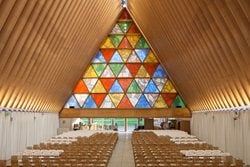
The potential of paper as a structural agent became globally evident in projects such as The Transitional 'cardboard' Cathedral in Christchurch, New Zealand, and the many paper log houses deployed for displaced communities worldwide.
Architecture as Humanitarian Action
Following the 1995 Kobe earthquake, Ban founded the Voluntary Architects’ Network (VAN), a non-governmental organisation dedicated to providing architectural assistance in disaster-hit regions.
VAN has since completed over 50 projects in 23 countries, delivering emergency shelters, community structures, and privacy partitions for refugees — from Rwanda to Maui to Ukraine.
Ban’s philosophy is clear and unwavering:
architecture must not serve only the privileged; it must uplift the vulnerable.
This ethos earned him numerous accolades, including the Mother Teresa Award for Social Justice (2017), but its deeper impact lies in the countless lives touched by his work.
Cultural Works That Weave Tradition and Innovation
Beyond humanitarian architecture, Ban has shaped significant cultural landmarks worldwide.
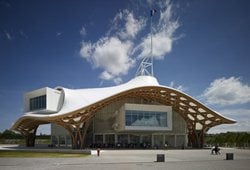
The Centre Pompidou-Metz stands as a monumental achievement in timber construction, its woven gridshell roof redefining contemporary structural expression.
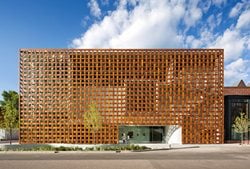
In the United States, the Aspen Art Museum and Cast Iron House in New York show his ability to balance contextual sensitivity with forward-looking design.
These works affirm the breadth of his practice: inventive yet humble, technically bold yet always guided by human experience.
A Global Educator and Mentor
For more than three decades, Ban has taught at institutions including Harvard, Cornell, and Columbia, engaging students directly in hands-on construction, often through VAN initiatives.
His pedagogy dissolves the divide between theory and practice: to learn architecture is to build — and to build is to serve.
A Gold Medal for a Generous Architecture
The 2026 AIA Gold Medal celebrates Shigeru Ban not only as a master architect, but as a humanitarian innovator, a material pioneer, and a teacher of purpose.
His body of work stands as a reminder that architecture can be both technically groundbreaking and profoundly empathetic — a discipline rooted in responsibility as much as imagination.
In honouring Ban, the AIA honours the belief that architecture can build a more sustainable, equitable world — one structure, one community, one idea at a time.
***
Cover photo: Shigeru Ban ©︎ The Japan Art Association / The Sankei Shimbun


 34
34
 84
84
 96
96
comment