

A few days after his passing, the architecture world pays tribute to Frank Owen Gehry, a master of deconstructivism and a revolutionary figure in contemporary design.
Gehry died on December 5, 2025, in Santa Monica, at the age of 96. Born in Toronto in 1929 and later becoming a U.S. citizen, he shaped nearly eight decades of architectural experimentation, infusing the discipline with an unprecedented sense of sculptural dynamism.
From a House in Santa Monica to the Global Stage
Gehry’s radical design path began with his own residence: the Gehry House in Santa Monica (1978), a raw architectural manifesto that wrapped an existing structure in corrugated metal, plywood, and asphalt — merging sculpture, construction, and conceptual art. He dubbed the approach “cheapscape,” marking the start of a creative vision that would shatter conventional forms and geometry.
Throughout his career, Gehry combined disruptive aesthetics with cutting-edge technology, often adapting aeronautics software to model his fluid, unpredictable forms. He treated materials like clay — titanium, glass, steel, even cardboard — reshaping the very idea of built space.
The Guggenheim Bilbao and the “Gehry Effect”
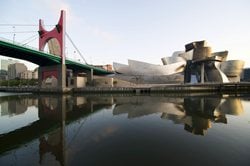
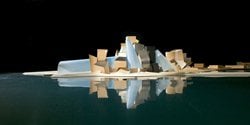
The Guggenheim Museum Bilbao (1997), with its sweeping titanium curves and interlocking volumes reflected in the Nervión River, transformed a post-industrial city into a global cultural destination.Guggenheim Museum Bilbao © FMGB Guggenheim Bilbao Museoa
Philip Johnson hailed it as “the greatest building of our time”, and the project gave rise to the “Bilbao Effect” — a term used worldwide to describe the regenerative power of architecture.
In 2021, Gehry remarked: “People are always telling me how I changed the city. I didn’t mean to change the city, I just meant to be part of the city.”
Between Art, Sculpture, and Architecture
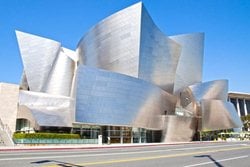
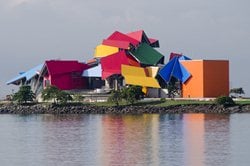
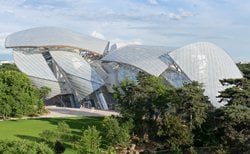
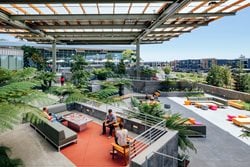
His prolific body of work includes iconic buildings such as the Vitra Design Museum in Weil am Rhein (1989), the Weisman Art Museum in Minneapolis (1993), the Dancing House in Prague (1996), the Walt Disney Concert Hall in Los Angeles (2003), New York by Gehry (2010), the Biomuseo Panama (2014), the Fondation Louis Vuitton in Paris (2014), and the Facebook Campus Expansion in Menlo Park (2019), culminating in the Guggenheim Abu Dhabi, set to open in 2026.
Architect Frank Gehry and Facebook founder Mark Zuckerberg discussing models of Facebook Campus Expansion at Menlo Park, ©Everett Katigbak, Facebook
Gehry also left his mark in product design — most notably with the Wiggle Side Chair (1972), made from cardboard, now considered one of the most groundbreaking design objects of the 20th century.
A Legacy That Continues to Inspire
Recipient of the Pritzker Prize (1989), the Presidential Medal of Freedom, and the Golden Lion for Lifetime Achievement at the Venice Biennale (2008), Gehry redefined the architect’s role in society, becoming a symbol of architecture’s power to inspire, provoke, and transform.
As Barack Obama stated during the Medal of Freedom ceremony: "Frank's work teaches us that while buildings may be sturdy and fixed to the ground, like all great art they can lift our spirits – they can soar and broaden our horizons."
Until the very end, Gehry continued designing with the same restlessness and passion that defined his entire career: “If you know what you’re going to do before you’re going to do it, don’t do it.”
An architecture shaped in the impossible, which continues to open new horizons for generations of architects, artists, and dreamers.


 75
75
 11
11
 56
56
 46
46
 49
49
 90
90
 65
65
 40
40
comment