

The Taichung Green Museumbrary opened to the public on 13 December 2025, marking a pivotal moment in Taiwan’s cultural landscape.
Located within the expansive 67-hectare Taichung Central Park, the project introduces a new institutional typology: the island’s first cultural complex to unite a metropolitan art museum and a central public library within a single, continuous architectural environment.
Conceived as part of the city’s long-term transformation of a former military airport into a green civic district, the Museumbrary is designed not as an object placed in the park, but as an inhabited extension of the landscape itself.
SANAA’s Largest Cultural Project Worldwide
Designed by SANAA, led by Kazuyo Sejima and Ryue Nishizawa, in collaboration with Ricky Liu & Associates Architects + Planners, the Taichung Green Museumbrary spans nearly 58,000 square metres.
It is both SANAA’s first public building in Taiwan and their largest cultural project to date, synthesising years of research into lightness, transparency, and spatial continuity.
Eight interconnected volumes of varying heights are wrapped in a delicate white expanded-metal mesh, forming a soft, permeable envelope that filters light and visually dissolves the building into the surrounding greenery.
A Library in a Park, an Art Museum in a Forest
The Museumbrary gently merges the programmes of the Taichung Art Museum (TcAM) and the Taichung Public Library, allowing spaces for reading, exhibitions, learning, and informal gathering to overlap and intersect.
The Public Library hosts more than one million physical and digital resources, while the museum’s programme focuses on contemporary art and global dialogue.
Together, they form a cultural landscape where knowledge is not compartmentalised, but experienced as a fluid continuum.
Architecture Shaped by Openness and Light
The building’s architecture is defined by porosity and accessibility.
A dual-layer façade — combining low-emissivity glass or metal cladding with an outer aluminium mesh — creates a luminous filter that modulates daylight while maintaining visual permeability.
The volumes are subtly lifted from the ground, allowing air, light, and movement to pass freely beneath the building.
At ground level, shaded plazas invite entry from all directions, strengthening the Museumbrary’s role as a democratic public space connected equally to the city and the park.
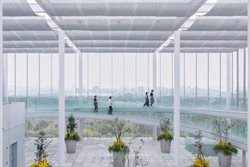
Above, the Culture Forest rooftop garden extends the experience into a shared elevated landscape, offering views across Central Park and the urban horizon.
Art, Dialogue, and Public Space
The Taichung Art Museum opens with the exhibition “A Call of All Beings: See you tomorrow, same time, same place” (13 December 2025 – 12 April 2026), bringing together over 70 artists from more than 20 countries.
The exhibition reflects the institution’s commitment to plurality, exchange, and environmental awareness, anchoring global conversations within a local context.
Complementing this, the museum launches its first Art Commissions in Public Space, featuring new works by Haegue Yang and Michael Lin, reinforcing art’s role as an everyday civic experience.
A Civic Space for Everyday Life
For Yi-Hsin Lai, Director of the Taichung Art Museum, the project represents a shift in how cultural institutions engage with their surroundings: “The integration of Taichung Art Museum with Taichung Public Library and the park has activated our thinking about the environment, culture, people and the city… We look forward to making this a welcoming space for visitors to create unique memories and experiences of their own.”
Echoing this vision, Kazuyo Sejima and Ryue Nishizawa describe the Museumbrary as a place where architecture supports new forms of communication and collective learning, dissolving the boundaries between disciplines and audiences.
A New Civic Landscape
The Taichung Green Museumbrary stands as a new model for cultural architecture in Asia — a building that replaces thresholds with openness and hierarchy with continuity.
Here, architecture does not dominate its setting but flows through it, creating a shared environment where art, literature, and nature form a single civic experience.
Between pages and trees, SANAA’s architecture offers Taichung a space not only to visit, but to inhabit.
***
Images courtesy of Taichung Art Museum. © Iwan Baan


 20
20
comment