
 Smiljan Radić Clarke, photo courtesy of The Pritzker Architecture Prize
The 2026 Pritzker Architecture Prize, widely regarded as the most prestigious recognition in architecture, has been awarded to Smiljan Radić Clarke, the Santiago-based architect whose work explores the delicate tension between permanence and impermanence in the built environment.
Across more than three decades of practice, Radić has cultivated an architectural language defined not by repetition but by inquiry. Each project begins as a response to its own conditions—social, historical, and environmental—allowing buildings to emerge from context rather than from a predefined stylistic identity.
In Radić’s words, architecture exists in the space between enduring monuments and fleeting constructions, between structures meant to last centuries and fragile interventions that may disappear almost as quickly as they appear. Within this temporal tension, his work seeks to create spaces that encourage people to pause, reflect, and rediscover their surroundings.
Fragility as architectural strength
The Pritzker jury praised Radić’s work for embracing uncertainty and vulnerability as fundamental architectural conditions. His buildings often appear provisional or delicate—almost unfinished—yet they provide environments that are protective, optimistic, and quietly joyful.
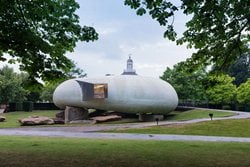
Rather than asserting permanence through monumental form, Radić’s architecture often suggests a state of suspension, where materials and volumes seem poised between stability and transformation.Serpentine Gallery Pavilion, photo courtesy of Iwan Baan
This sensibility is reflected in projects such as the Serpentine Gallery Pavilion 2014 in London, where a translucent fiberglass shell rests upon massive natural stones, creating a structure that appears both ancient and futuristic. Light filters softly through the envelope, maintaining a porous relationship between interior and park landscape.
Material storytelling
While his buildings may appear austere or elemental, they are grounded in precise construction and careful material orchestration. Concrete, stone, timber, and glass are deployed not simply as structural elements but as narrative tools shaping light, sound, and spatial atmosphere.
At the Teatro Regional del Bío-Bío in Concepción (2018), for instance, a translucent façade mediates daylight while simultaneously supporting acoustic performance inside the theatre. Construction becomes a form of storytelling, where texture, mass, and material relationships carry as much meaning as the overall form.
Teatro Regional del Bío-Bío, photo courtesy of Iwan Baan
Architecture rooted in place
Radić’s work consistently emerges from the specific conditions of each site. Buildings may be partially embedded in the ground, oriented to respond to climate, or developed through adaptive reuse of existing structures.
Projects such as Restaurant Mestizo in Santiago (2006) or the extension of the Chilean Museum of Pre-Columbian Art (2013) demonstrate this approach, where architecture grows out of landscape, history, and cultural memory rather than replacing them.Restaurant Mestizo, photo courtesy of Gonzalo Puga
Even in smaller projects—such as House for the Poem of the Right Angle in Vilches (2013)—Radić creates introspective spaces where carefully framed openings invite light, time, and reflection into daily life.
House for the Poem of the Right Angle, photo courtesy of Cristobal Palma
An architecture of empathy
Underlying Radić’s practice is a profound sensitivity to the human experience of space. His buildings often feel protective and inward-looking, designed to shape how architecture is perceived over time rather than as immediate visual spectacle.
This emotional intelligence extends beyond construction. In 2017, Radić founded Fundación de Arquitectura Frágil in Santiago, a platform dedicated to public exchange and research into experimental architectural ideas.
A global yet personal practice
Founded in 1995, Radić’s studio operates with a relatively small team yet has produced projects across Europe and the Americas, including works in Austria, Croatia, France, Italy, Spain, Switzerland, and the United Kingdom.Vik Millahue Winery, photo courtesy of Cristobal Palma
The jury highlighted this condition as part of the architect’s distinctive voice: a practice developed “from the edge of the world,” capable of reaching the fundamental core of architecture and the human condition.
With this recognition, Smiljan Radić Clarke becomes the 55th laureate of the Pritzker Architecture Prize, joining a lineage of architects whose work continues to redefine the relationship between architecture, culture, and society.


 26
26
 3
3
 2
2
 22
22
 6
6
comment