
 Kengo Kuma ©Designhouse
Japanese architect Kengo Kuma will receive the Andrée Putman Lifetime Achievement Award at the 2027 Créateurs Design Awards, the program’s highest honor recognizing a career whose influence has shaped architecture and design across generations and continents.
The award will be presented in Paris on January 16, 2027, during the Créateurs Design Awards ceremony at the Shangri-La Paris. One of two Legacy Awards conferred by the organization, the distinction is selected by members of the Créateurs Design Association and is not open to submissions.
Architecture as a Dialogue with Nature
Born in Yokohama in 1954, Kuma founded Kengo Kuma & Associates in Tokyo in 1990, later opening a Paris office in 2008. Over more than three decades, his practice has developed an architectural language rooted in the relationship between built form and the natural environment, while continually reinterpreting Japanese tradition through a contemporary lens.
Rather than treating nature as a backdrop to architecture, Kuma’s work has consistently sought a more porous relationship between materials, landscape and human experience. This search for harmony has become one of the defining threads running through his career.
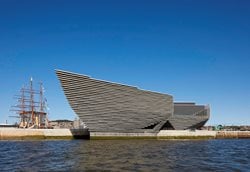
Among the projects highlighted by the Créateurs Design Awards are the Japan National Stadium in Tokyo, V&A Dundee in Scotland, the FRAC Marseille, the Cité des Arts et de la Culture in Besançon, and the Saint-Denis Pleyel station in Paris, completed in 2024.V&A Dundee, ©Ross Fraser McLean
The Long-Distance Runner
Reflecting on the recognition, Kuma describes his career through the metaphor of long-distance running — a continuous journey guided by the search for harmony between architecture, people and the natural world.UCCA Clay Museum, ©Fangfang Tian
“In my design practice, I consider myself a long-distance runner. I believe the most important thing is to keep running over the long term with a single goal in mind: achieving harmony between humans and nature. Writing is also a vital part of this journey; the ideas that come to me while running often take the form of essays and books. More than anything, I am honored that the Lifetime Achievement Award recognizes the 'entirety' of everything I do.”
Kengo Kuma, 2026
Centro de Arte Moderna Gulbenkian, ©Fernando Guerra
The image of the long-distance runner captures the continuity of Kuma’s practice: architecture is not understood as a succession of isolated achievements, but as an ongoing pursuit in which buildings, writing and ideas form part of the same trajectory.
In this sense, the Andrée Putman Lifetime Achievement Award recognizes not one project, but the entirety of a body of work developed over more than three decades around a persistent dialogue between humans, architecture and nature.Chidori Prostho Museum Research Center, ©Daici Ano
Between Tradition and Modernity
The award is named after Andrée Putman, the influential French designer whose work was marked by a constant dialogue between historical references and contemporary design.
According to the Créateurs Design Awards, Kuma’s practice reflects that same tension between tradition and modernity. Over more than thirty years, his work has repeatedly questioned how architecture can help restore the relationship between people and the natural world, translating that search into buildings across different cultures and continents.
Previous recipients of the Andrée Putman Lifetime Achievement Award include Norman Foster, Tadao Ando and Christian de Portzamparc.Audeum, ©Yongbaek Lee
A Career Recognized Worldwide
Alongside his architectural practice, Kuma has been a professor at the University of Tokyo since 2009.
His recent recognitions include the Imperial Prize and Japan Art Academy Prize in 2024, the Prix Versailles for Best Museum in 2025 and the 38th Louis I. Kahn Award in the same year.The Gallery of Saint Maurice Cathedral in Angers, France, ©Guillaume Amat
The Andrée Putman Lifetime Achievement Award now adds another milestone to a career defined less by a single architectural language than by a persistent question: how can buildings exist in deeper harmony with nature, material and human life?
For Kuma, that question remains an ongoing journey rather than a destination — a long run through architecture, landscape and time.
Asakusa Culture Tourist Information Center, © Takeshi Yamagishi
The Exchange, ©Martin Mischkulnig
Memu Meadows, ©Shinkenchiku-sha
SunnyHills at Minami-Aoyama, ©Daici Ano
Tokorozawa Sakura Town Kadokawa Culture Museum, ©Forward Stroke Inc.


 10
10
 125
125
 36
36
 51
51
 70
70
 6
6
 45
45
 16
16
comment