
 Daniel Libeskind, Ph. Roland Horn © The Japan Art Association
Daniel Libeskind has been named the 2026 Praemium Imperiale laureate for Architecture, joining a distinguished line of architects recognised by the Japan Art Association for their international influence and contribution to culture.
The winners of the 37th edition were announced today, September 8, 2026, simultaneously in Tokyo, Paris, Rome, Berlin, New York and London. The award will be presented in Tokyo on October 28, during a ceremony presided over by Prince Hitachi, Honorary Patron of the Japan Art Association. Each laureate receives 15 million yen, a diploma and a medal.
Architecture shaped by memory
Born in Łódź, Poland, in 1946, Daniel Libeskind moved to the United States as a teenager and settled with his family in the Bronx. Before turning to architecture, he trained seriously as a musician — an experience that would remain deeply embedded in his understanding of rhythm, structure and the physical perception of space.
He graduated from the Cooper Union for the Advancement of Science and Art in New York in 1970 and later completed a master’s degree in History and Theory of Architecture at the University of Essex.
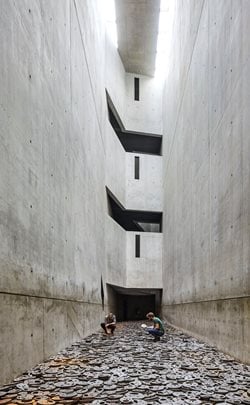
His international breakthrough came in 1989, when he won the competition for the Jewish Museum Berlin. The project established a language that would become central to his work: fractured geometries, sharp spatial sequences and architecture conceived as a medium through which absence, trauma and collective memory can be made physically perceptible.
Jewish Museum, Berlin, 2001. ©Studio Daniel Libeskind, ©Hufton+Crow
From Berlin to Ground Zero
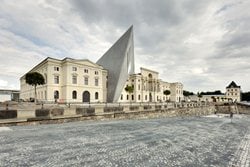
For Daniel Libeskind, architecture has never been understood as an autonomous object. Music, literature, philosophy and history all feed into a practice in which buildings are expected to carry meaning as well as function.Dresden Museum of Military History, Dresda, Germany, 2011. P.h Bitter Bredt, courtesy of Architekt Daniel Libeskind Agv
In 2003, Libeskind was appointed master planner for the reconstruction of the World Trade Center site in New York, after which his studio moved its headquarters to the city. Since then, Studio Libeskind has developed cultural, civic, commercial and residential projects around the world, including museums, concert halls, convention centres, university buildings, hotels and towers.
National Holocaust Monument, Ottawa, Canada, 2017. Ph. ©Doublespace Photography
His work consistently explores architecture’s ability to give form to narratives that are difficult to express in words. As the biographical materials accompanying the award emphasise, Libeskind sees architecture as something closely connected to the body and believes that it has a responsibility to speak where silence otherwise prevails.Citylife, PWC Tower, Milano, Italy, 2020. Ph. ©Piermario Ruggeri
A practice still looking forward
Now based between New York and Berlin, Daniel Libeskind continues to work with his wife and professional partner, Nina Libeskind.
Among his current projects is the Albert Einstein Discovery Center in Ulm, Einstein’s birthplace. Conceived to communicate the scientist’s discoveries while also celebrating his commitment to pacifism, the project brings together two recurring strands in Libeskind’s architecture: the memory of the past and the possibility of imagining a different future.Atrium at Sumner, Brooklyn, USA, 2024. Ph. ©Hufton+Crow
His career has previously been recognised with honours including the Goethe Medal, the Hiroshima Art Prize, the Dresden Peace Prize and the European Civil Rights Prize of the Sinti and Roma.
The Praemium Imperiale, established in 1988 by the Japan Art Association, recognises major international achievements in five fields: Painting, Sculpture, Architecture, Music and Theatre/Film. Often described as an arts equivalent of the Nobel Prize, it honours careers whose impact extends beyond individual works to influence culture internationally.
Alongside Daniel Libeskind for Architecture, the 2026 laureates are Jenny Holzer for Painting, Andy Goldsworthy for Sculpture, Herbert Blomstedt for Music and Cate Blanchett for Theatre/Film.
Left to Right: Jenny Holzer, Ph. Beatrice Morits. ©The Japan Art Association; Andy Goldsworthy, 2024, Courtesy Andy Goldsworthy; Herbert Blomstedt, Photo Paul Yates; Cate Blanchett ©The Japan Art Association


 94
94
 64
64
 109
109
 36
36
 25
25
-

H&S QUALITY CONSTRUCTION LLC
comment.