

The Prix Versailles officially launched its 12th edition on 4 May 2026 with the announcement of the seven projects selected for the World’s Most Beautiful Museums 2026 list.
The selection brings together architectures that differ widely in geography, scale and subject matter, yet all share the ability to transform the museum into a powerful spatial and narrative device. As Jérôme Gouadain, Secretary General of the Prix Versailles, noted, these works stand out for the quality of their architectural interpretation and staging, capable of elevating history, memory, science and innovation through built form. At the end of the year, three of the seven museums will also receive an additional World Title in the categories Prix Versailles, Interior or Exterior.
From Abu Dhabi to Shenzhen, the museum as urban and climatic landmark
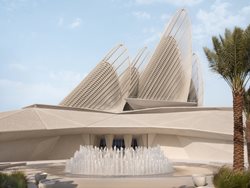
Among the selected projects is the Zayed National Museum in Abu Dhabi, designed by Foster + Partners and inaugurated on 3 December 2025 in the Saadiyat Cultural District. ©Zayed National Museum
Dedicated to the legacy of Sheikh Zayed bin Sultan Al Nahyan, it retraces more than 300,000 years of history through six permanent galleries. The building is immediately recognisable through its five steel towers, inspired by the wings of a falcon in flight. These structures are not only symbolic, but also incorporate natural ventilation principles, reinforcing the museum’s climatic performance. With its warm sandy tones and natural light, the museum positions itself as a threshold between land and sky, extending toward the coast through Al Masar Garden.
The Shenzhen Science & Technology Museum, inaugurated on 1 May 2025, interprets the museum as a new icon for the Greater Bay Area. Designed by Zaha Hadid Architects, the building is described as a vast spaceship embracing the city. Its design responds to the site’s subtropical climate, including solar radiation, temperature, humidity, prevailing winds and air quality.Shenzhen Science & Technology Museum © Virgile Simon Bertrand
The façade, made of 95,000 irregular stainless-steel panels, is defined by a colour gradient shifting from deep blue to grey depending on the light. Here, architectural invention works together with environmental performance, while a sequence of outdoor terraces extends the galleries into the surrounding park.
The museum as sensory experience and narrative landscape
Also included in the list is the Xuelei Fragrance Museum, presented as the world’s largest museum dedicated to perfumery. Designed by Shenzhen Huahui Design Co., the building takes the form of eight red-brick cylindrical volumes, evoking the processes of distillation and refinement behind fragrance production.Xuelei Fragrance Museum © Xuelei Fragrance Museum
The architecture guides visitors along a path conceived almost like a scent trail, with around 300 interactive smelling stations leading up to a rooftop garden. The museum thus becomes a contemporary manifesto for an intangible heritage that remains deeply embedded in shared human history.
In Tokyo, MoN Takanawa: The Museum of Narratives, opened on 28 March 2026, spans around 29,000 square metres within the Takanawa Gateway City development, on the exact site of Japan’s first railway line. Designed by Kengo Kuma, the museum is conceived as an immersive and participatory cultural hub at the intersection of art, tradition, technology and education. MoN Takanawa © Yasuyuki Takaki
Its light and ethereal architecture — made of wood, layered glass, perforated surfaces and diffused light — dissolves the boundary between inside and outside, accompanied by more than 200 plant species. In sharp contrast with the surrounding skyscrapers and infrastructure, the project proposes a redefinition of the contemporary city through porosity, fragility and seasonal transformation.
Memory, loss and the civic role of architecture
More introspective in character is The Lost Shtetl Jewish Museum, located in the plains of Lithuania, near the historic centre of Šeduva. The museum tells the story of the vanished world of the shtetl, the small Jewish communities that once populated the country before the Holocaust. Lost Shtetl Museum © Enea Landscape Architecture
Designed by Finnish architect Rainer Mahlamäki, with Enea Landscape Architecture, the complex takes the form of a small village: a sequence of “houses”, each corresponding to a different chapter of the exhibition. Its blind gables and grey tiled exterior seem almost to dissolve into the rural landscape, while the adjacent Memorial Park extends its role as a living monument.
In the United States, in Texas, the National Medal of Honor Museum is dedicated to recipients of the country’s highest military honour for valour. The project, the final work by Rafael Viñoly Architects PC, is organised around a large steel-clad Exhibition Hall suspended 12 metres above the ground over a landscaped Field of Honor.National Medal of Honour Museum © Vinoly_NMOHM
Five megacolumns represent the branches of the U.S. Armed Forces, while a central oculus symbolically refers to the U.S. Space Force. The museum builds an immersive narrative around courage, sacrifice and integrity, giving the institution a civic role that goes beyond commemoration.
Monumentality and intercultural dialogue
The selection is completed by the Islamic Civilization Center in Tashkent, Uzbekistan, initiated by President Shavkat Mirziyoyev as both a tribute to traditional architecture and a new contemporary landmark for the capital. Center of Islamic Civilization © Center of Islamic Civilization
The project draws inspiration from the monumental vocabulary of the Timurid era, with large portals and a dome rising 65 metres into the air. At its heart, the spectacular Qur’an Hall combines light, sound and multimedia to create a contemplative atmosphere, while the wider programme includes research, education and cultural promotion through archives, a library, an Islamic academy and conference facilities. Its scientific programme involved around 1,500 researchers from more than 40 countries, turning the museum into an active tool for intercultural dialogue.
The museum as a contemporary form of common good
Taken together, the seven projects selected by the Prix Versailles 2026 offer a broad and layered idea of the museum. No longer only a place of preservation, it emerges here as a space capable of connecting architecture, memory, technology, landscape and citizenship. In all cases, the sustainability promoted by the prize is not reduced to environmental performance alone, but expands into a more complex vision in which culture becomes a way of interpreting — and even transcending — the notion of environment itself.
From the climatic monumentality of the Zayed National Museum to the narrative delicacy of MoN Takanawa, from the civic dimension of the National Medal of Honor Museum to the memorial fragility of The Lost Shtetl Jewish Museum, the 2026 list highlights how the contemporary museum has become one of the most significant places where architecture measures its capacity to give form to the common good.



 108
108
 51
51
 1
1
 17
17
 27
27
 11
11
comment